

Profitability primarily indicates to what extent a company is able to produce and sell its goods in the market place for a profit. Broadly, it is a reflection of how well a company renders a product and/or service and to what degree it is able to generate sales. The EBITDA margin in this analysis is used as an indicator of profitability. The EBITDA Margin of Serbia’s economy stood at a solid 8% in 2013 – eight cents of EBITDA was generated per euro of sales. Average firms were not able to track the economy’s trends dictated by larger profitable firms, due to lack of possibility of becoming more competitive, in terms of production costs, market power, visibility and other key competitiveness factors which create gaps between small and large businesses.
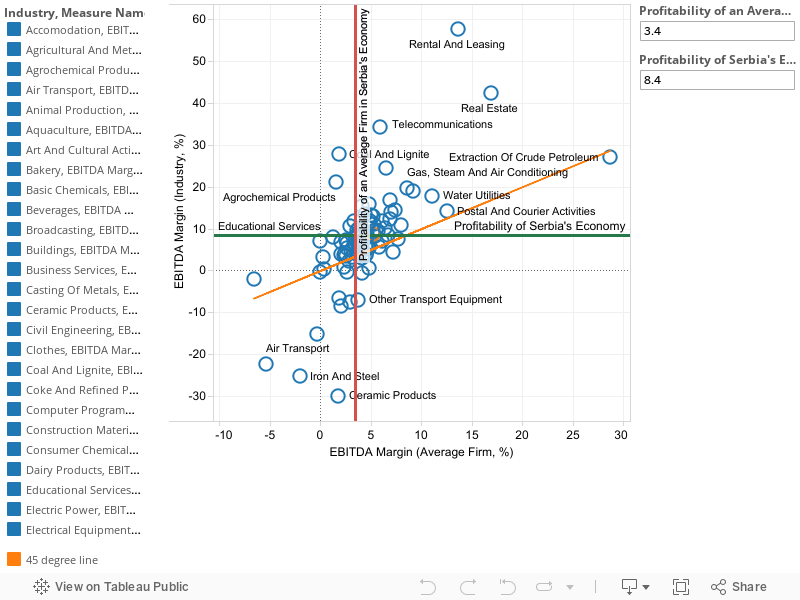
Grafikon ispod pruža detaljan uvid u profitabilnost industrija u privredi Srbije. On prikazuje rasprostranjenost industrija prema profitabilnosti njihovih prosečnih firmi i profitabilnosti industrije kao celine. Profitabilnost ogromne većine industrija u privredi Srbije određena je zaradnom snagom jedne ili nekoliko velikih firmi unutar tih industrija. Najprofitabilnije industrije u privredi Srbije su one koje su najefikasnije i najdelotvornije proizvodile i prodavale svoje proizvode na tržištu i time sistematski postizale izvanredne stope osnovne profitabilnosti. One se nalaze u potkvadrantu I (iznad horizontalne zelene linije i desno od vertikalne crvene linije) i pokazuju marže profita koje su iznad obe prosečne vrednosti za privredu. Pored toga, ove industrije imaju najveći potencijal da podstaknu privredni rast kroz kontinuiranu i povećanu aktivnost.
Grafikon – Profitabilnost industrija (2009-2013)
Profitability primarily indicates to what extent a company is able to produce its products, sell them on the market and thus achieve profit. Broadly speaking, it reflects the success of a company in producing products or providing services and its ability to achieve sales. The EBITDA margin in this analysis is used as an indicator of profitability. The EBITDA margin of the Serbian economy in 2013 was a decent 8% – for every euro of sales value, an additional eight cents of EBITDA was generated. Average firms were unable to follow the trends of the economy dictated by larger profitable companies because they could not increase their competitiveness in terms of production costs, market position, visibility, and other key competitiveness factors that create a gap between small and large firms.
The graph below shows us a detailed overview of the profitability of the sectors that make up Serbia's economy. It depicts the distribution of sectors according to the profitability of the average firms operating in them and the profitability of the sector. The profitability of the vast majority of sectors in the Serbian economy was determined by the ability of one or a small number of large firms in those sectors to achieve profit. The most profitable sectors in Serbia's economy are those that most efficiently and effectively produce and sell their goods on the market and thus systematically achieved outstanding profitability rates in their core activities. These sectors are grouped in sub-quadrant I (above the horizontal green line and to the right of the vertical red line) and achieve profit margins above both averages of the economy. These sectors are the most profitable, and therefore the most suitable for business development. In addition, these sectors have the greatest potential to drive economic development through continued operations and increased scope.
Graph – Profitability of sectors (2009-2013)