
Glavni cilj našeg istraživanja jeste da osvetli najperspektivnije industrije, sa potencijalom da podstaknu održivi rast i razvoj privrede Srbije kroz unapređenu međunarodnu konkurentnost i izvoznu aktivnost. Najperspektivnije industrije u Srbiji su one koje poseduju adekvatne atribute i obezbeđuju resurse preduzećima kako bi ona proizvodila međunarodno konkurentne proizvode, uz profitabilno, produktivno i dinamično poslovanje. Takve industrije su sposobne da unaprede svoj rast, ostvare profit vlasnicima preduzeća, generišu zaposlenost, postanu još konkurentnije na globalnim tržištima i time značajno doprinesu ukupnom ekonomskom razvoju zemlje. Takve industrije se mogu smatrati i najpogodnijim za razvoj preduzeća. To ne znači da će svako preduzeće u perspektivnim industrijama biti uspešno i međunarodno konkurentno. Pre će biti da prosečno preduzeće ima veće šanse za uspeh u takvoj industriji. Da li će određeno preduzeće uspeti zavisi pre svega od atributa na nivou preduzeća.
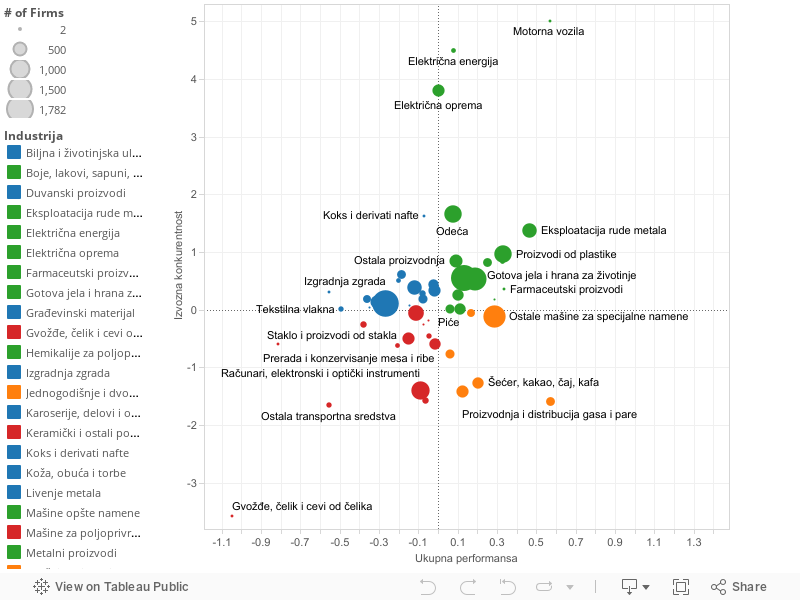
The performance-competitiveness matrix, presented in the graph below, provides an overview and comparison of industries based on the characteristics and structure of international competitiveness and overall performance. It depicts the dispersion of 53 tradable industries according to their overall industry performance and their export competitiveness. Each industry is presented by a bubble, while the size of each bubble is determined by the number of firms within an industry. The more firms comprising an industry, the larger is the bubble representing that industry. Quadrant I is comprised of 18 promising industries, both internationally competitive and well performing. These industries have achieved both positive export competitiveness and overall performance in the five-year period, from the strike of the crisis in 2009 until 2013. Industries located in this quadrant can be considered the current stars of Serbia’s economy. Every third (18 out of 53) observed tradable industry is located in this quadrant, meaning that products of these industries were widely competitive on foreign markets, while the performance of these industries was relatively high.
Grafikon – Performanse industrija (2009-2013)
The main goal of our research is to shed a light on the most promising sectors, those that have the potential to drive sustainable growth and development of Serbia’s economy through enhanced competitiveness in foreign markets. The sectors with the greatest potential in Serbia are those that provide firms with resources enabling them to produce internationally competitive products while operating profitably, productively, and dynamically. These sectors are capable of increasing growth, generating profit for firm owners, creating new jobs, thereby becoming more competitive globally and thus making a significant contribution to the overall economic development of the country. Such sectors can be considered the most suitable for firm development. This does not mean that every firm within a sector with potential will actually be successful and internationally competitive. However, an average firm has a greater chance of succeeding within such a sector. Whether an enterprise succeeds or not depends primarily on the individual attributes of that enterprise itself.
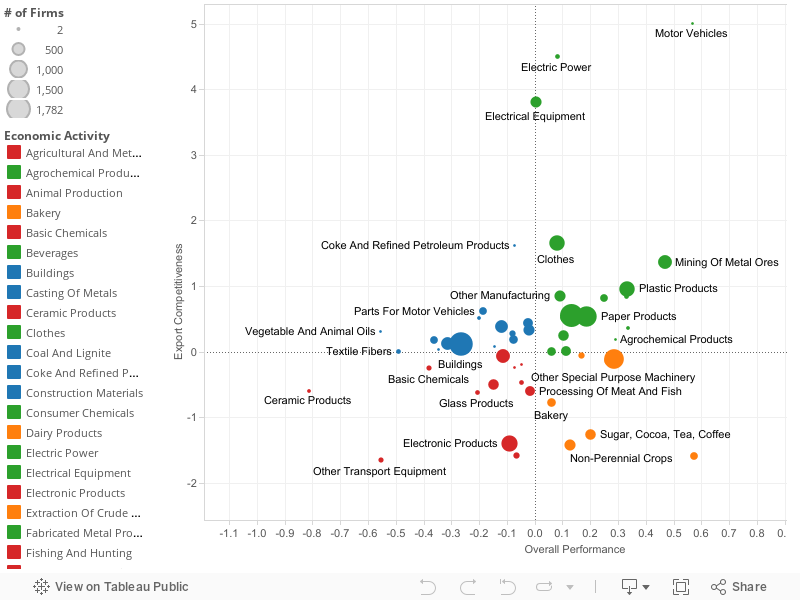
The performance-competitiveness matrix, presented in the graph below, provides a comparative overview of sectors based on their characteristics and the structure of international competitiveness and overall performance. It shows the distribution of 53 tradable sectors based on their overall performance and export competitiveness. Each sector is represented by a circle, and the size of the circle indicates the number of firms operating in that sector. The more firms operating in a sector, the larger the circle. Quadrant I consists of 18 sectors that possess both global potential and good performance. These sectors achieved positive export competitiveness and overall performance in the five-year period from the onset of the crisis in 2009 until 2013. This quadrant clearly represents a desirable location for every sector. The sectors listed in this quadrant can currently be considered the „stars“ of the Serbian economy. Every third (18 out of 53) observed tradable sector is located in this quadrant, meaning that the products of these sectors are competitive in the vast majority of foreign markets, while the performance of these sectors is relatively high.
Graph – Performance by sector (2009-2013)