
CEVES has identified 18 industries in the Serbian economy that, in spite of general obstacles in the business environment, insufficient macroeconomic stability, and a lack of financial resources, possess potential to foster further economic growth. Those industries exhibit strong export competitiveness and growth capabilities and can be considered the most promising, the most suitable and the most attractive industries for firm development. The main goal of this case study is to provide a sound knowledge about the performance and competitiveness of one selected industry, and to determine the reasons explaining that performance and competitiveness, by focusing on the identification and understanding of critical success factors. Considering the industry selection criteria (more in report, page 119), the manufacture of Fabricated Metal Products (FMP) was selected.
The Fabricated Metal Products (FMP) industry involves the transformation of metals into intermediate and final products using one or a combination of three processes – fabrication, preparation, and finishing – that can also encompass a host of other techniques such as forging, stamping, bending, forming, welding, machining and assembly. Companies in the sector purchase raw ferrous and nonferrous metals (e.g. carbon, aluminium, steel, titanium, brass, copper), generally the primary inputs in fabricated metal production, in either raw or semi-finished directly form primary producers or large-scale distribution companies and sell them to a range of industrial customers. Generally, this industry consists of a relatively large number of small and medium enterprises, with a relatively high share of exporters among them. The Fabricated Metal Sector had the highest number of companies of all sectors in the first quadrant and a HHI of only 150. Furthermore, the industry exhibited an improvement in export competitiveness, but with a high potential for further enhancement. The Fabricated Metal Products sector is located in the first quadrant and ranks 13th in terms of competitiveness and 15th in terms of industry performance out of 53 tradable industries.
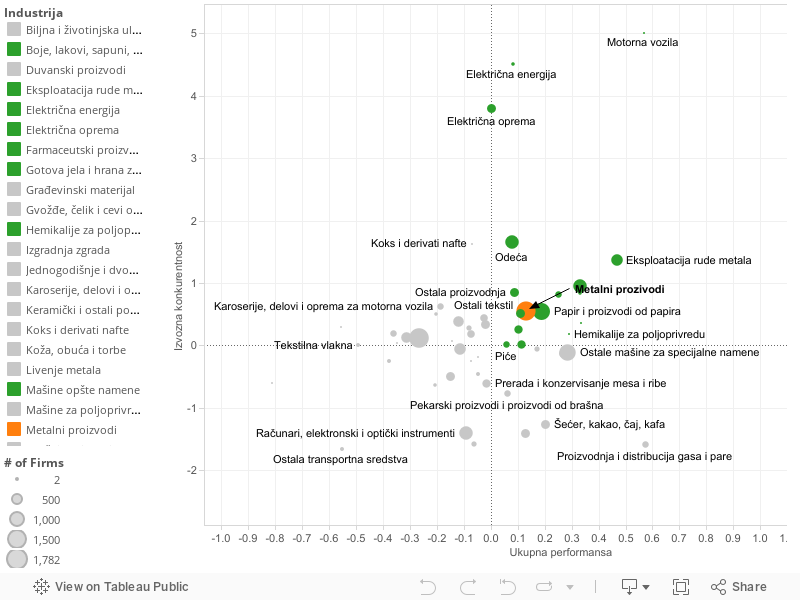
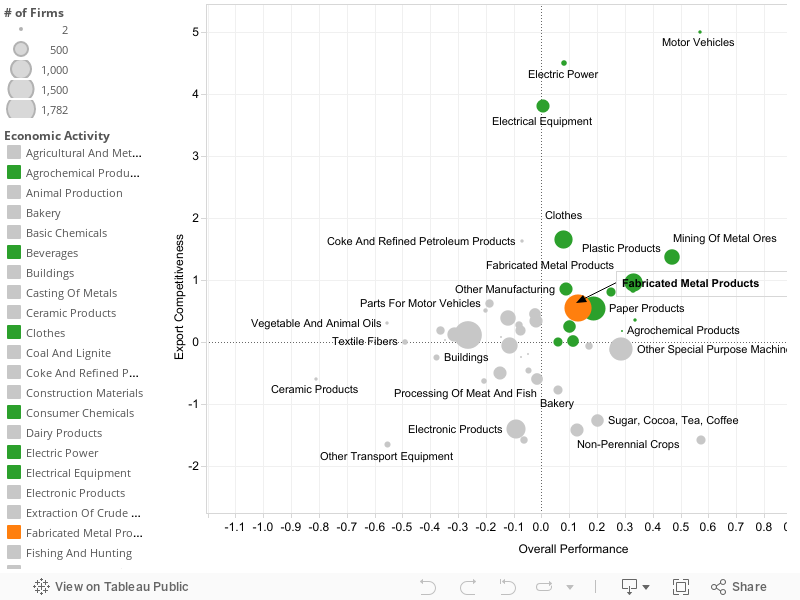
The Industry of Fabricated Metal Products is one of the best performing industries in the Serbian economy, possessing adequate attributes and resources for firms to produce internationally competitive products while operating relatively sustainably and dynamically. The main characteristics, which determine the position of this industry in the performance-competitiveness matrix, are a great number of firms, a relatively solid overall performance and strong international competitiveness. The FMP industry is located in the first quadrant of the performance-competitiveness matrix, which indicates that this industry has achieved both positive export competitiveness and overall performance in the five-year period, from the strike of the crisis in 2009 until 2013. This quadrant obviously represents the desirable and preferable location for every industry. Industries located in this quadrant can be considered the current stars of Serbia’s economy. The exact position of the FMP industry within the performance-competitiveness matrix is shown in the figure below. The FMP industry is presented by an orange bubble, whose size is determined by the number of firms that operate in that industry. Other best performing industries, located in the first quadrant, are colored blue, while the remaining industries of the Serbian economy are colored grey.
Case study – Fabricated Metal Products
Graph – Industry overall performance and export competitiveness (2009-2013)
CEVES has identified 18 industries in the Serbian economy that, in spite of general obstacles in the business environment, insufficient macroeconomic stability, and a lack of financial resources, possess potential to foster further economic growth. These industries exhibit export competitiveness and growth capabilities and can be considered the industries with the most potential, the most suitable, and the most attractive for firm development. The main goal of this case study is to provide quality knowledge about the performance and competitiveness of the observed industry and to determine the reasons explaining that performance and competitiveness, by focusing on the identification and understanding of critical success factors. Considering the industry selection criteria (more in report, page 118), the Fabricated Metal Products (FMP) industry was selected.
Generally speaking, the Fabricated Metal Products (FMP) industry involves the transformation of metals into semi-finished and finished products using one or a combination of three processes – manufacturing, preparation, and finishing – which can also encompass a host of other techniques such as forging, stamping, bending, forming, welding, machining, and assembly (FMR, pp. 2-3). Companies in this industry procure ferrous and non-ferrous metals (e.g., carbon, aluminum, steel, titanium, brass, copper), generally the primary inputs in fabricated metal production, either as raw or semi-finished products directly from primary producers or large distributors, and sell them to a range of industrial customers. Generally, this industry consists of a relatively large number of small and medium-sized enterprises, with a relatively high number of exporters among them. The Fabricated Metal Products sector has the largest number of companies of all sectors in the first quadrant, and an HHI of only 150. Furthermore, this sector has shown an improvement in export competitiveness, with high potential for further advancement. The Fabricated Metal Products sector is located in the first quadrant and ranks 13th in competitiveness and 15th in industry performance out of 53 tradable sectors.
Metal products manufacturing is among the best-performing sectors in the Serbian economy, possessing adequate attributes and resources that enable companies operating in this sector to produce goods competitive on the global market while simultaneously operating relatively sustainably and dynamically. The main characteristics determining this sector's position in the performance and competitiveness matrix are the large number of firms, relatively satisfactory overall performance, and strong global competitiveness. The metal products manufacturing (MPM) sector is located in the first quadrant of the performance and competitiveness matrix, indicating that this sector has achieved both positive export competitiveness and overall performance in the five-year period from the beginning of the crisis in 2009 to 2013. This quadrant clearly represents a desirable location for any sector. Sectors listed in this quadrant can currently be considered the „stars“ of the Serbian economy. The exact position of the MPM sector within the performance and competitiveness matrix is shown in the figure below. The MPM sector is represented by an orange circle, the size of which is determined by the number of firms operating in that sector. Other best-performing sectors located in the first quadrant are marked in green, and other sectors of the Serbian economy are marked in gray.
Case Study – Fabricated Metal Products
Chart – Overall Sector Performance and Export Competitiveness (2009-2013)