
CEVES has identified 18 industries in the Serbian economy that, in spite of general obstacles in the business environment, insufficient macroeconomic stability, and a lack of financial resources, posses potential to foster further economic growth. Those industries exhibit strong export competitiveness and growth capabilities and can be considered the most promising, the most suitable and the most attractive industries for firm development. The main goal of this case study is to provide a sound knowledge about the performance and competitiveness of one selected industry, and to determine the reasons explaining that performance and competitiveness, by focusing on the identification and understanding of critical success factors. Considering the industry selection criteria (more in report, page 119), the manufacture of Fabricated Metal Products (FMP) was selected.
The Fabricated Metal Products (FMP) industry involves the transformation of metals into intermediate and final products using one or a combination of three processes – fabrication, preparation, and finishing – that can also encompass a host of other techniques such as forging, stamping, bending, forming, welding, machining and assembly. Companies in the sector purchase raw ferrous and nonferrous metals (e.g. carbon, aluminium, steel, titanium, brass, copper), generally the primary inputs in fabricated metal production, in either raw or semi-finished directly form primary producers or large-scale distribution companies and sell them to a range of industrial customers. Generally, this industry consists of a relatively large number of small and medium enterprises, with a relatively high share of exporters among them. The Fabricated Metal Sector had the highest number of companies of all sectors in the first quadrant and a HHI of only 150. Furthermore, the industry exhibited an improvement in export competitiveness, but with a high potential for further enhancement. The Fabricated Metal Products sector is located in the first quadrant and ranks 13th in terms of competitiveness and 15th in terms of industry performance out of 53 tradable industries.
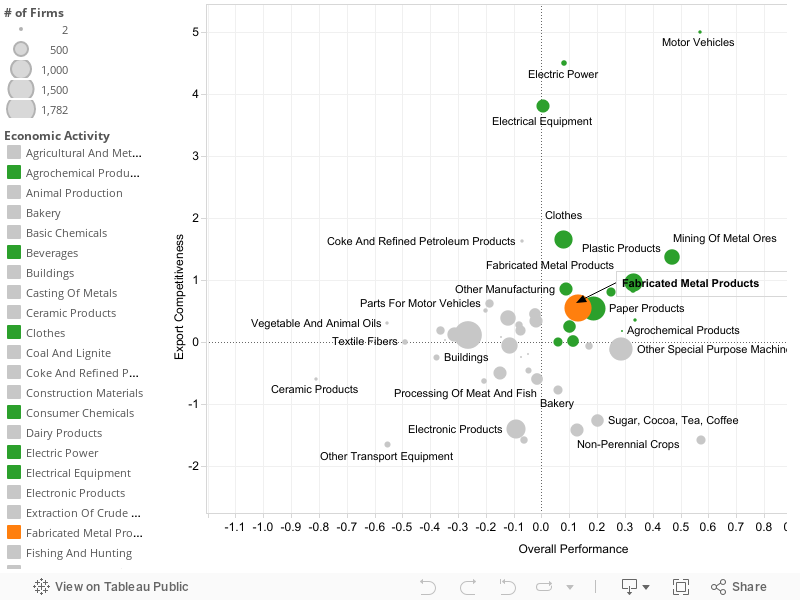
The Industry of Fabricated Metal Products is one of the best performing industries in the Serbian economy, possessing adequate attributes and resources for firms to produce internationally competitive products while operating relatively sustainably and dynamically. The main characteristics, which determine the position of this industry in the performance-competitiveness matrix, are a great number of firms, a relatively solid overall performance and strong international competitiveness. The FMP industry is located in the first quadrant of the performance-competitiveness matrix, which indicates that this industry has achieved both positive export competitiveness and overall performance in the five-year period, from the strike of the crisis in 2009 until 2013. This quadrant obviously represents the desirable and preferable location for every industry. Industries located in this quadrant can be considered the current stars of Serbia’s economy. The exact position of the FMP industry within the performance-competitiveness matrix is shown in the figure below. The FMP industry is presented by an orange bubble, whose size is determined by the number of firms that operate in that industry. Other best performing industries, located in the first quadrant, are colored blue, while the remaining industries of the Serbian economy are colored grey.
Case study – Fabricated Metal Products
Graph – Industry overall performance and export competitiveness (2009-2013)
CEVES je identifikovao 18 sektora u srpskoj privredi koji, uprkos generalnim preprekama u poslovnom okruženju, nedovoljnoj makroekonomskoj stabilnosti, i nedostatku finansijskih resursa, imaju potencijal da podstaknu dalji privredni razvoj. Ti sektori ostvaruju izvoznu konkurentnost i sposobnost rasta i mogu se smatrati sektorima sa najviše potencijala, najpogodnijim i najprivlačnijim sektorima za razvoj firmi. Glavni cilj ove studije slučaja jeste da omogući sticanje kvalitetnog znanja o performansi i konkurentnosti posmatranog sektora i da utvrdi razloge kojima se objašnjavaju ta performansa i konkurentnost, i to usredsređujući se na prepoznavanje i razumevanje ključnih faktora uspeha. Uzimajući u obzir kriterijume za selekciju sektora (opširnije u izveštaju, strana 118), odabran je sektor Proizvodnje metalnih proizvoda (PMP).
Opšte uzev, sektor proizvodnje metalnih proizvoda (PMP) predstavlja transformaciju metala u poluproizvod i finalni proizvod korišćenjem jednog ili kombinacije tri procesa – proizvodnje, pripreme i završne obrade – koje same takođe mogu da obuhvataju niz drugih tehnika kao što su kovanje, štancovanje, savijanje, oblikovanje,zavarivanje, obrada i montaža (FMR, str. 2-3). Kompanije u ovom sektoru nabavljaju crne i obojene metale (npr. ugljenik, aluminijum, čelik, titanijum, mesing, bakar), uglavnom primarne ulaze u proizvodnji metalnih proizvoda, bilo kao sirove ili poluproizvode direktno od primarnih proizvođača ili velikih distributera i prodaju ih nizu industrijskih kupaca. Generalno, ovaj sektor se sastoji od relativno velikog broja malih i srednjih preduzeća, među kojima je relativno veliki broj izvoznika. Sektor proizvodnje metalnih proizvoda broji najveći broj kompanija od svih sektora u prvom kvadrantu, a HHI od samo 150. Dalje, ovaj sektor je pokazao unapređenje izvozne konkurentnosti, i to sa visokim potencijalom za dalje napredovanje. Sektor proizvodnje metalnih proizvoda je lociran u prvom kvadrantu i na 13. je mestu po konkurentnosti a na 15. po sektorskoj performansi od 53 razmenljivih sektora.
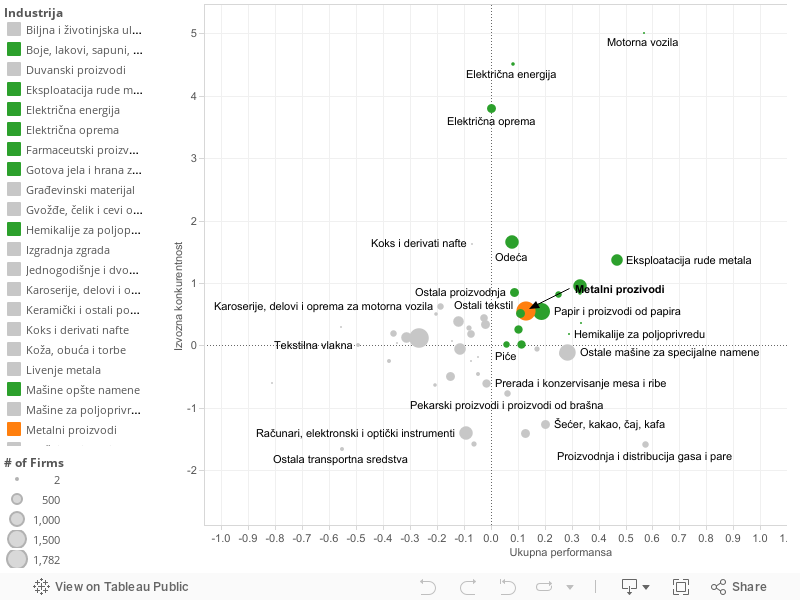
Proizvodnja metalnih proizvoda je među sektorima sa najboljom performansom u privredi Srbije, i poseduje adekvatne atribute i resurse čijom primenom firme koje posluju u ovom sektoru mogu da proizvedu dobra konkurentna na globalnom tržištu dok istovremeno posluju relativno održivo i dinamično. Osnovne karakteristike koje određuju položaj ovog sektora u matrici performanse i konkurentnosti jesu veliki broj firmi, relativno zadovoljavajuća performansa u celini i snažna konkurentnost na globalnom nivou. Sektor PMP je lociran u prvom kvadrantu matrice perforanse i konkurentnosti, što ukazuje da je ovaj sektor postigao i pozitivnu izvoznu konkurentnost i ukupnu performansu u petogodišnjem periodu od početka krize 2009. do 2013. godine. Ovaj kvadrant očigledno predstavlja poželjnu lokaciju za svaki sektor. Sektori navedeni u ovom kvadrantu mogu se u ovom trenutku smatrati „zvezdama“ srpske privrede. Tačan položaj sektora PMP u okviru matrice performanse i konkurentnosti je dat na slici u nastavku. Sektor PMP je predstavljen narandžastim krugom, čija je veličina određena brojem firmi koje posluju u tom sektoru. Drugi sektori sa najboljom performansom locirani u prvom kvadrantu su označeni zelenom bojom, a ostali sektori srpske privrede su označeni sivom bojom.
Studija slučaja – Proizvodnja metalnih proizvoda
Grafik – Ukupna performansa sektora i izvozne konkurentnosti (2009-2013)