
We present to you this SPECIAL BULLETIN devoted to what is currently the second hottest economic topic in the country, the budget. We address the first hottest topic, the resolution of the sanctions issue related to NIS, in the CEVES View section of this special bulletin. We will show some of the results of our months-long work: a summary analysis of execution and projections for the state’s largest investment projects, an answer to the question of whether the structure of fiscal spending supports socio-economic development (and how much it has changed since 2014), as well as a table that may intimidate you at first glance, but is the best possible summary of the entire 2026 draft budget.
We are leaving our observations on macroeconomic developments and growth projections for 2026 for the December issue. Here we will point out that it is now even in the draft budget “admitted” that economic growth in 2025 will be around 2%, and that there is no doubt this is due to a decline in both private and public investment, especially when the defence sector is excluded.
The key conclusion of our analysis of investment plans and projections is that, although the number of large projects where implementation is delayed and the number of projects where spending has occured somehawt ahead of schedule, the projects that are delayed are precisely those most closely linked to EXPO Belgrade 2027. Table 1 shows projects with planned annual spending above EUR 20 million, compared to the plan at the time the budget was adopted. For projects related to EXPO Belgrade 2027, the total projected value now stands at around EUR 4.4 billion (about EUR 90 million more than a year ago), while at the same time it is estimated that in 2025 around 37% of the originally planned amount (around EUR 343 million) will not be executed, and around EUR 305 million will be shifted to 2027. The National Stadium stands out in particular, where the planned amount for 2025 is reduced by around 85% and moved to 2027 and even 2028, as do the accompanying roads and connections to Surčin, while for most other large projects delays generally do not increase or there is even some acceleration. In this situation, when the projects that are most problematic in terms of implementation dynamics overlap with the fixed deadline of the EXPO in mid-2027, the question arises whether the pressure to complete the works “at any cost” will increase the tendency to circumvent procedures, reduce transparency and compromise the safety of structures. In other words, whether this pattern may heighten risks similar to those that most likely led to the collapse of the canopy at the railway station in Novi Sad.
Table 1. How are the largest investment projects progressing?

__
*The 2026 budget also includes: road projects for EXPO needs (EUR 60 million).
***Construction of the Belgrade bypass on the E-70/E-75 motorway, section: bridge over the Sava River at Ostružnica–Bubanj Potok (sections 4, 5 and 6); construction of the E-763 motorway, section: New Belgrade–Surčin; construction of a new bridge over the Sava River in Belgrade; construction of the railway between Zemun Polje and the National Stadium; tunnel from Karađorđeva Street to the Danube slope.
The problem is sharpened by the fact that, given the current projection of capital expenditure execution for the entire state up to the end of the third quarter, execution in the fourth quarter would need to accelerate to a high 49% of the total value for 2025, a level not recorded in the past decade. It should also be noted that since 2012 the highest percentage of execution in the last quarter occurred in 2024, at 47.4%, while the average for the same period is 40.7%. It is therefore not surprising that the projection of capital expenditures has been revised from EUR 6.46 billion, as planned in the revised fiscal strategy for 2025, to EUR 6.23 billion in the October projection of the Ministry of Finance.
What does Serbia spend on, and what do the EU and CEE spend on?
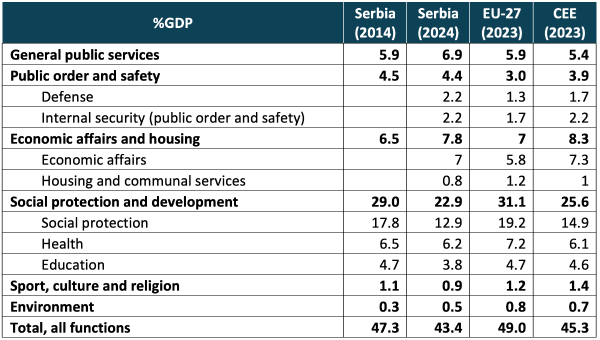
Without thorough reforms that strengthen productivity and institutional capacity, Serbia’s budget is doomed to redistribute funds instead of supporting development. The functional structure of public expenditure clearly shows where the priorities of economic policy in recent years have been.
Table 2. Functional structure of public expenditure in Serbia, the EU and CEE in 2014 and 2024 (2023 for the EU and CEE)
__
Sources: Ministry of Finance and Eurostat
The increase in spending on economic activities from 6.5% to 7.8% of GDP between 2014 and 2024 appears positive. However, this increase comes almost entirely from large infrastructure projects, which at the outset responded to obvious needs, but now it is unclear what vision they serve. Subsidies to the economy also account for an unusually large share (2.5% of GDP) and have grown the fastest after capital expenditures, while spending that directly builds the productive capacity of the economy remains marginal. Support for entrepreneurship has been reduced in the 2026 budget and amounts to only EUR 16.5 million, less than the cost of EXPO donations (EUR 20.5 million). What is needed instead are programmes that create synergies and build capacities.
In 2026 we do not see any shift toward a development-oriented spending structure. On the contrary, in spite of the promises from 2014, priorities continue to move away from what supports long-term growth. The central government budget is rising to 32% of GDP, but this increase is driven by defence, internal security and large projects, while economic affairs remain based on subsidies rather than support for innovation, SMEs and local development. At the same time, social protection, health, education and the environment stagnate or lag behind, in some cases significantly so, even though these areas determine productivity, quality of life and the reduction of inequalities. The budget is thus becoming more “expensive”, but not more development oriented. If after 2026 we continue to expand the army, police and projects of questionable value, while saving on schools, hospitals and social infrastructure, Serbia will enter the next decade with weak growth and growing social tensions. A clear change of priorities is needed, from spending for control over people toward investment in people.
In the same spirit of analyzing priorities and the transparency of public finances, we inform you that the National Convention on the European Union (of which CEVES is an active member) has also submitted its detailed analysis of the Draft Budget for 2026 and the Fiscal Strategy for the 2025-2027 period to the relevant institutions of the Republic of Serbia (the Government, the Ministry of Finance, the National Assembly, and parliamentary groups). This analysis also includes recommendations for improvement in the next budget cycle.
The Convention’s official statement can be viewed here, and the detailed analysis of the budget and fiscal policies can be found at this link.
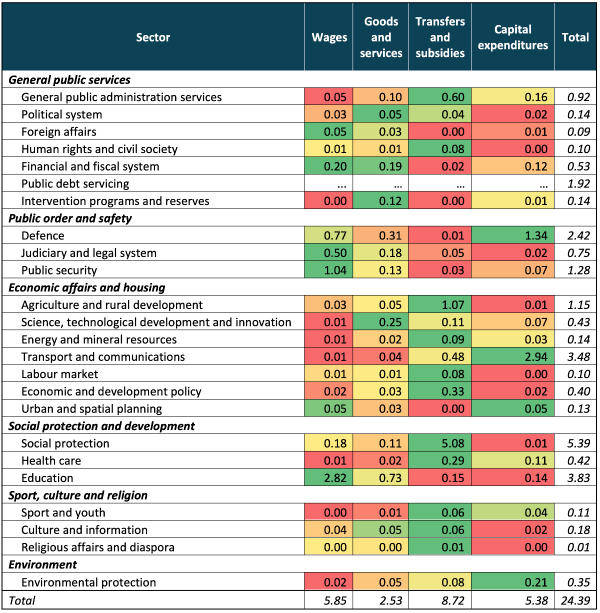
Finally, do not be alarmed by the table that follows. It is the most concise possible representation of the structure of the 2026 budget in terms of what is spent and how it is spent. Each row represents one sector. We have grouped them as in Table 2, but the tables do not fully overlap in coverage. Here we look only at central budget spending, without health and social securty funds and local governments.
Table 3. 2026 draft budget: What is spent and how, in % of GDP*
__
*The colours in the table indicate the share of each economic category in total sectoral spending. Darker green marks the largest, yellow the medium, and red the smallest relative amount.
From these sectors we can see, for example, why in the previous discussion we did not “blame” general public services for their size. The administration is not necessarily oversized (although it probably is when we take into account that a considerable part of spending on goods and services consists of temporary and agency employment). The total wage bill in the central budget in this segment amounts to only 0.16% of GDP.
Based on the table, we see that most state budget spending goes to transfers and subsidies, as much as 7.67%, which can be attributed to high allocations in the social protection sector (5.08%). These funds are mainly intended for the social insurance funds, the pension fund and the health insurance fund. The reliance of these funds on significant transfers from the state budget points to problems in their financing and raises questions about their long-term sustainability. Subsidies also dominate in the agriculture sector, where they amount to 1% of GDP and constitute the largest spending category in this sector, while capital expenditures are negligible. These data point to an inefficient allocation of funds which, instead of being directed into capital projects that would increase productivity and capacity in agriculture, mostly go to one-off payments and current subsidies with questionable long-term development impact.
Spending on goods and services in the science sector is also not as high as it appears, given that it relates to the own revenues of scientific institutions, for which it is not known how they are spent.
Although we welcome steps toward greater availability of certain fiscal data in this and the previous budget cycle, which have enabled this kind of thorough analysis, we emphasise that key information and decisions are still sometimes missing or not explained. What is lacking are summary analytical overviews and substantive explanations that would enable an informed discussion of the proposal.
Continuous monitoring of the Reform Agenda
Within the National Convention on the EU, in November 2025 an Intersectoral Working Group (IWG) was established for monitoring the Reform Agenda (RA). Within the IWG, in addition to five subgroups responsible for each of the RA areas, CEVES, in cooperation with Transparency Serbia, has set up a horizontal subgroup for monitoring the budgetary implications of the Reform Agenda. The subgroup will assess whether adequate budget funds have been allocated for the key steps envisaged by the RA and will also analyse the actual fiscal costs and obligations of the state arising from investments financed through WBIF. At the IWG plenary session held on 13 November 2025, all subgroup members met and adopted an activity plan for 2026.
CEVES View: On NIS
We cannot comment on the second most important economic topic of the moment without addressing the first: NIS. We will not enter into a detailed analysis of this issue, as key information, such as the exact negotiating positions with the US and Russia, as well as the researched privatization models, are not and will not be publicly available. However, from an economic standpoint, we do not expect permanent market destabilization, but rather the risk of short-term disruptions and the politically driven transfer of costs to certain groups. The complete and long-term exclusion of derivatives processed in the Pančevo Refinery would have extremely severe consequences for consumers and the economy, as there are significant limitations in import logistics (terminals, storage, transport) that cannot be removed in the short term, and it is uncertain how much they can be reduced in the medium term. The economic and political price of ignoring the demands of the US administration, through extended sanctions and blockades in supply, is undoubtedly higher than the domestic political price of the “betrayal of Russia” narrative. When it comes to gas, we can assume that the current discount will probably not persist, whether it is roughly paid through the price of Russian capital’s exit from NIS or through future supply contracts. However, Russian gas can technically be replaced by other sources, albeit at a higher cost and with an adjustment period. The current economic price of the buyout is also not the problem. In the first step, the nationalization of NIS or the buyout of the Russian stake is a mere stroke of the pen. However, both certainly carry different legal risks (including possible international arbitrations), as well as a fiscal cost through increased public debt to be repaid in the future, especially if the company is overpaid. Formally, in one scenario, a law is written, and in the other, a cheque, but the conditions under which this is sustainable depend on the consent of multiple foreign policy actors, not just domestic will. Nevertheless, we do not expect the collapse of either the oil derivatives or gas markets. In the worst case, there will be a combination of short-term disruptions and price fluctuations that the government will use (if not engineer!) to “explain” the decision as an economic necessity, rather than a geopolitical choice.

 SR
SR