The budget proposal for the next year is focused on even greater capital investments, primarily related to the „Expo“ project, and on increasing salaries for public sector employees. However, expenditures will also include over 220 billion dinars for interest and related costs.
The new budget projects total revenues and receipts exceeding 2.3 trillion dinars, which is an increase of approximately 173 billion, or eight percent, compared to the revenue amount projected by the budget rebalance for 2024. On the other hand, total expenditures and outlays are projected at slightly less than 2.7 trillion dinars, with a projected fiscal budget deficit of three percent of gross domestic product (GDP).
It is further stated that a fiscal budget deficit of three percent of gross domestic product (GDP) is projected, and that public debt at the government sector level is decreasing and will remain at 47.5 percent of GDP by the end of the year.
The maintenance of the government sector deficit at three percent of GDP until 2027 and a decrease in public debt to 46.5 percent of GDP are also projected.
Furthermore, approximately 763 billion dinars have been allocated for capital investments from this budget, which represents 7.4 percent of GDP. Of this amount, the largest funds will certainly be allocated to projects within the „Jump into the Future – Serbia 2027“ plan.
Additionally, expenditures for employee salaries in this budget amount to 471.6 billion dinars, and this budget also provides for an eight percent salary increase for the public sector, with the exception of the education sector, which will receive an 11 percent increase.
The Budget Proposal also shows that over 220 billion dinars are allocated for interest payments and related borrowing costs, which is 19 percent more compared to the budget rebalance for the current year.
Šormaz: Salaries increased flatly, instead of based on fair job evaluation
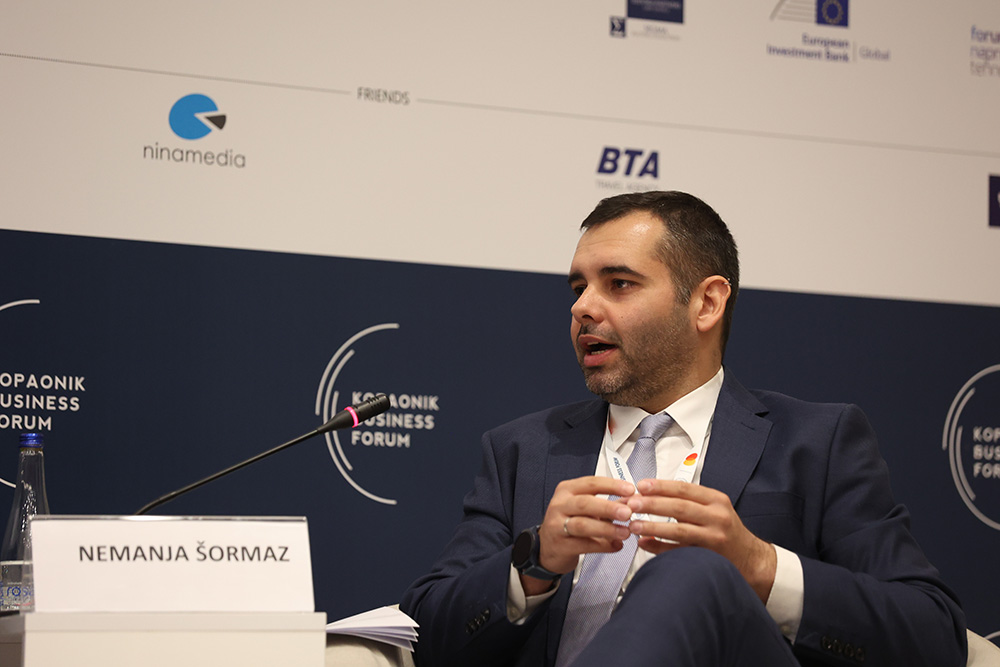
Nemanja Šormaz, Director of the Centre for Advanced Economic Studies (CEVES), tells Danas that the budget appears expected at first glance and similar to previous years.
„It is unfavorable that a deficit increase is recorded. Although the projected level does not threaten macroeconomic stability or public debt sustainability, it is concerning that the deficit growth is mainly due to the increase in current expenditures. Foreign interest payments are significantly increasing, by as much as 26 percent, as a consequence of more intensive borrowing under unfavorable conditions in the previous period. Salaries have again been increased flatly by 11 percent, above GDP growth, instead of based on fair job evaluation. The hiring freeze continues to enable political rewards for favored institutions, and deepens the problem of public administration (in)efficiency,“ he warns.
Public investments without a long-term plan and development priorities
Šormaz also points out that public investment plans remain ambitious at six percent of GDP, placing Serbia among the leading countries in Europe.
„However, it is probably also the only country in Europe investing so much without any long-term plan, development priorities, and clear criteria for project selection. Moreover, a high level of investment does not guarantee their quality – neither in terms of executed works nor in terms of contribution to GDP growth and improvement of the quality of life,“ our interlocutor believes.
The largest funds are directed towards transport infrastructure, Šormaz reminds. „This is met with public and economic approval, while local and communal projects, which more directly affect the quality of everyday life, are significantly lagging behind. In the defense sector, investments are high, accounting for 20 percent of total investments, or over a billion euros, and are further increasing due to the procurement of Rafale aircraft, but as in many other sectors, the question of effectiveness and capacity, primarily human, for adequate use of this equipment and infrastructure arises,“ he states.
Šormaz also warns that a significant portion of investments raises doubts about their justification.
„For the broader concept of the ‘Expo 2027’ project, which includes the stadium, over 680 million euros will be allocated in 2025 alone, while additional increased funds are planned for 2026. Spending so much money hastily in such a non-transparent manner and without a cost-benefit analysis is unacceptable. There are also less conspicuous investments, equally questionable in terms of usability and price justification. Over 100 million euros in the next three years is planned for the implementation of electronic public administration registers. In the absence of a legally mandated Investment Plan, clear feasibility studies for such projects should at least be presented to the public, and a transparent oversight mechanism for public procurement should be established,“ he urges.
The budget finances the status quo, not the necessary economic transformation
He adds that support for the economy remains inert and unadapted to changes in the environment.
„The budget structure has been unchanged for years, despite significant market challenges – such as the recession in Germany, unfavorable borrowing conditions, expected trade disruptions, the fight for talent in the labor market, and the need for a green transition. Instead of necessary transformations, the budget finances the status quo. Subsidies of one billion euros in agriculture are intended to maintain the current state, while over 200 million euros continue to be directed towards stimulating investments by large and foreign companies. This will create additional pressure on the labor market,“ Šormaz explains.
He also reminds that direct support for domestic small and medium-sized enterprises (SMEs) is only about 10 percent of that amount and has been around 20 million euros for years.
„The lack of measures to stimulate domestic investments is particularly concerning. SMEs have been investing insufficiently for a long time, and the current situation further reduces their profits and investments, which undermines competitiveness and is also reflected in the increased current deficit. The return of the tax credit for small and medium-sized entities could stimulate the growth of their investments by 40 percent, or about 1.5 billion euros, but such a measure is not planned in this year's budget,“ Šormaz points out.
He also emphasizes that the Export Credit and Insurance Agency (AOFI) does not plan additional intensive support for exporters.
„In addition, there are neither concrete guidelines nor adequate funds for the digital and green transformation of the economy, despite the EU further tightening regulations and requirements. A more decisive policy and targeted budget planning are necessary for SMEs to overcome current challenges and maintain or improve competitiveness,“ says Šormaz.
Source: Danas.rs