
Author: Vojislav Stojanović, economist
The rebalance significantly increased the spending framework compared to the initial budget, by 1.5% of GDP (1.45 billion euros), or by 6.3%. Macroeconomic and fiscal developments in the first half of the year were more favorable than expected and opened up additional fiscal space, which was further expanded by increasing the deficit from 3.0% to 3.5% of GDP (from 2.9 to 3.4 billion euros). This would have exceeded the limit of the general fiscal rule if its application had not been postponed until 2029. Additional funds were predominantly directed towards transfers, subsidies, and one-off measures for the population, about 1.2% of GDP (1.2 billion euros), or four-fifths of the total increase. Capital expenditures increased by only 0.2% of GDP (170 million euros), with a simultaneous reduction or postponement of the volume of certain investments, including projects related to EXPO. Thus, the additional fiscal space was not used to address structural weaknesses and build state administrative, regulatory, and other capacities, although numerous long-standing shortcomings are present in these areas. The rebalance therefore has a primarily distributive and short-term consumption character, and significantly less of a development-investment character.
Figure 1 on one hand shows the items whose appropriations were increased by the rebalance, and on the other hand the sources from which these increases were financed. The total increases amount to about 2.0% of GDP (1.9 billion euros), which is more than the net increase in expenditures of 1.5% of GDP, as certain items were reduced simultaneously. The largest individual increase is recorded in defense, 0.35% of GDP (330 million euros), including the procurement of equipment and the new General Staff building, followed by subsidies to Putevi Srbije and Koridori Srbije, 0.2% of GDP (200 million euros). Four items through which (pre-election) measures for the population are predominantly realized (child protection, PIO Fund subsidies, employment incentives, and a new appropriation of the Ministry of Finance which most likely represents the budget part of the one-off payment to adult citizens) together increase by 0.65% of GDP (620 million euros). The central budget, however, does not include the entire amount of the announced aid package of about 1% of GDP (980 million euros), as part of it is financed from the Share Fund.
On the sources side, around a quarter of the increase is financed by a higher deficit, 0.53% of GDP. A slightly larger share, 0.55% of GDP (EUR 520 million), comes from non-tax revenue, namely profit and dividend payments. Part of this is the customary transfer of NBS profits, while the source of the remainder is unknown (public enterprises?). Tax revenue, by contrast, rises by a net 0.26% of GDP (EUR 240 million), as higher VAT and corporate income tax collection is partly offset by lower excise duties on petroleum products. The rest of the increase is covered by interest savings, 0.13% of GDP, and by cuts to funding for large infrastructure projects, 0.35% of GDP (EUR 330 million). In other words, the rise in current spending is largely financed by one-off resources, and it is unclear whether alternative uses of those resources, especially investment in the development of public enterprises, would not have been more justified.
Separately from expenditure, the financing account provides for around 1.5% of GDP (EUR 1.4 billion) for the acquisition of domestic financial assets, most likely the purchase of the Russian stake in NIS. The transaction does not affect the deficit, but it increases the state's borrowing needs.
Chart 1: 2026 budget revision: where the additional money goes and where it comes from (% of GDP)
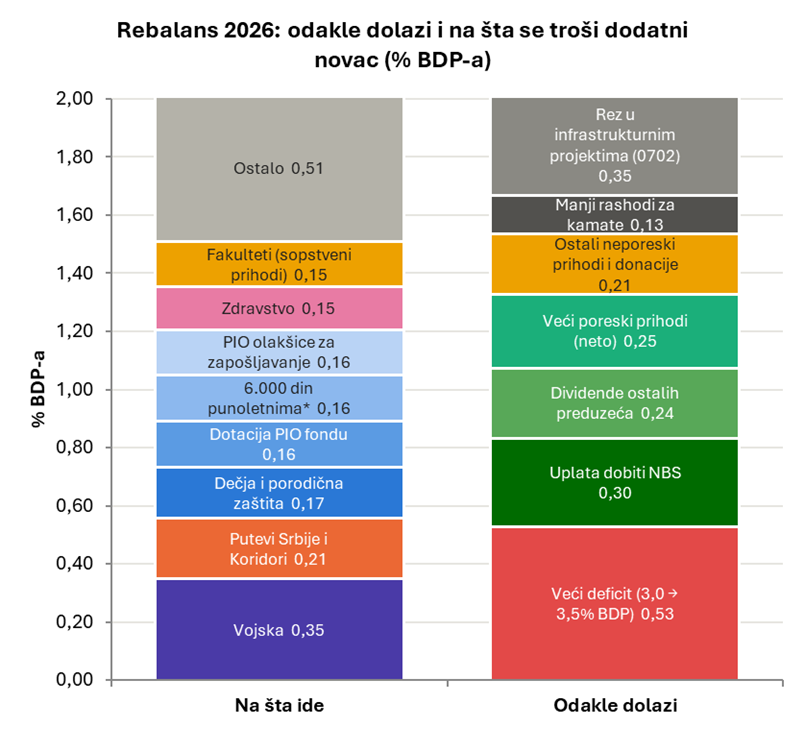
Note: The left bar shows the items whose appropriations have been increased, and the right bar shows the sources of financing, including interest savings and reduced funds for large infrastructure projects. Therefore, both bars (2.0% of GDP) are higher than the net increase in expenditures (1.5% of GDP). Excluding financial transactions (principal repayment, NIS).
* Budget share of the one-off payment to adult citizens, according to the Fiscal Council. Source: Law on the Budget of the Republic of Serbia for 2026 and its revision; NBS; CEVES calculations.
The rebalance increased both the revenue and expenditure sides of the budget, with revenue growth driven primarily by non-tax revenues, and expenditure increases largely resulting from higher current expenditures and pre-election measures by the authorities. Assuming GDP growth of 3.5%, total revenues and receipts increased from 21.6% to 22.6% of GDP (961 million euros, +4.7%). The largest contribution to revenue growth comes from non-tax revenues, whose increase is planned by 0.7 pp of GDP (678 million euros, +26.2%), almost entirely due to the unprecedented revised plan for the payment of profits and dividends of public enterprises.[1] It should be noted that such revenues are volatile and one-off in nature, so they should not be considered a permanent source of public spending financing. On the other hand, tax revenues increased by only 0.2 pp of GDP (241 million euros, +1.4%), largely thanks to a decrease in excise revenues, due to the Government's decision to further reduce the excise tax rate on oil derivatives. Additionally, in the first half of the year, a stronger collection of taxes was observed, and the Government clearly expects this trend to continue, so the rebalance envisages an increase in revenues from VAT and profit tax by about 0.2 pp of GDP each (440 million euros, +3.7%). On the expenditure side, total expenditures and outlays increased by 1.5 pp of GDP (1,452 million euros, +6.3%). The biggest change in the rebalance is seen among current expenditures (+1.3 pp of GDP), and among them, subsidies to OOSO, subsidies, and social expenditures stand out, which we discuss in more detail later in this text. Capital expenditures increased from 5.4% of GDP to only 5.6% of GDP.
Figure 1: Projection of the consolidated central government balance, and planned revenues and expenditures of the central government level in the budget and budget rebalance as % of GDP, assuming economic growth of 3.5%
| Category | Projection 2026 | Budget 2026 | Rebalance 2026 |
| I TOTAL REVENUES | 22,44% | 21,62% | 22,62% |
| Tax revenues | 18,93% | 18,62% | 18,87% |
| Of which: Corporate profit tax | 2,81% | 2,46% | 2,68% |
| Value Added Tax | 9,93% | 9,70% | 9,96% |
| Excise duties | 3,73% | 4,06% | 3,85% |
| Non-tax revenues | 3,45%* | 2,72% | 3,43% |
| II TOTAL EXPENDITURES | 27,20% | 24,63% | 26,17% |
| Current expenditures | 19,13% | 18,90% | 20,24% |
| Of which: Expenditures for employees | 5,97% | 5,87% | 6,00% |
| Subsidies | 2,43% | 1,92% | 2,18% |
| Grants to international organizations | 0,11% | 0,10% | 0,10% |
| Transfers to mandatory social security organizations | 3,52% | 3,54% | 4,00% |
| Social protection from the budget | 2,06% | 1,90% | 2,09% |
| Capital expenditures | 7,52%** | 5,40% | 5,58% |
* Non-tax revenues are significantly affected by one-off inflows, which makes it difficult to make projections based on historical trends, so this figure should be taken with a certain reservation.
** Artefact of Rafale payment in Q1.
The increase in the planned deficit to 3.5% of GDP by the rebalance represents a deviation from the fiscal discipline established after the consolidation period and would exceed the limit prescribed by the general fiscal rule if its application had not been suspended until 2029. According to that rule, the maximum fiscal deficit is 3% of GDP if the public sector debt is below 45% of GDP; 1.5% if the debt is between 45% and 55%; 0.5% if it is between 55% and 60%; while with debt above 60%, the fiscal position must be balanced.
The structure of expenditure increases in the rebalance is more focused on current consumption than on development investments. Our analysis shows that, viewed by economic categories, the growth of expenditures is largely driven by an increase in subsidies and transfers, by 1.2% of GDP. In contrast, capital expenditures increased by only 0.16% of GDP, while expenditures on goods and services and expenditures for employees increased by 0.16% and 0.12% of GDP, respectively. Planned expenditures for interest and other public debt servicing costs were simultaneously reduced by about 0.13% of GDP. This structure does not indicate a significant redirection of the budget towards expenditures that directly increase public capital and potential growth, but rather primarily towards current transfers, subsidies, and other forms of consumption. The shift towards current consumption is particularly questionable given that part of the increase in transfers relates to announced pre-election one-off aid measures for the population, whose primary effect is to increase disposable income and consumption in the short term, rather than expanding the economy's production capacities.
The largest single change among appropriations in the rebalance relates to funds for the acquisition of domestic financial assets, within the budget financing part, which are most likely related to the potential acquisition of a stake in NIS. Program 2301 – Regulation, management, and supervision of the financial and fiscal system increased by almost EUR 1.6 billion or 1.7% of GDP, of which approximately EUR 1.4 billion relates precisely to this appropriation. Although the budget documentation does not specify its purpose, the scope and nature of this item suggest that it is related to the potential acquisition of a stake in NIS, which state officials have previously announced. It should be emphasized, however, that this item is not classified as a budget expenditure, but as an expense for the acquisition of financial assets within the financing account. In other words, through this transaction, the state would exchange monetary funds for financial assets – ownership in a company – so it is not recorded as current or capital expenditure, but as a financial transaction. Such an expense increases the state's total financing needs, but it does not represent an expenditure that directly enters into the calculation of the budget deficit.
Top 10 programs in the rebalance by amount of increase.
| Program | Change (EUR) | Change as % of GDP | Growth (%) | Explanation/main cause of increase |
| 2301 Financial and fiscal system | 1.584.144.126 | 1,66 | 532 | Part of financing account; not an expenditure; most likely related to NIS |
| 1703 Operations of the Ministry of Defence and Armed Forces | 331.233.666 | 0,35 | 14 | Procurement of equipment and new General Staff building |
| 0701 Traffic supervision | 199.009.335 | 0,21 | 47 | Subsidies to Public Enterprise Roads of Serbia |
| 0903 Family-legal protection | 165.838.900 | 0,17 | 15 | Pre-election aid measures |
| 0901 Pension and disability insurance | 152.566.070 | 0,16 | 6 | Pre-election aid measures |
| 0802 System of Work | 149.481.833 | 0,16 | 196 | Dotations OOSO |
| 2005 Higher Education | 146.928.713 | 0,15 | 18 | Own revenues of faculties included in the budget; does not affect the deficit |
| 2402 Intervention funds | 98.053.956 | 0,10 | 183 | 0902 Social Protection |
| 2102 Support for Government Operations | 94.233.828 | 0,10 | 8 | Pre-election aid measures |
| General Secretariat of the Government; NGO grants | 71.301.432 | 0,07 | 92 | Among the more significant increases in appropriations are programs 1703 – Operations of the Ministry of Defence and the Serbian Armed Forces, as well as 0701 – Traffic Supervision. The former relates to the announced increase in the budget for the military |
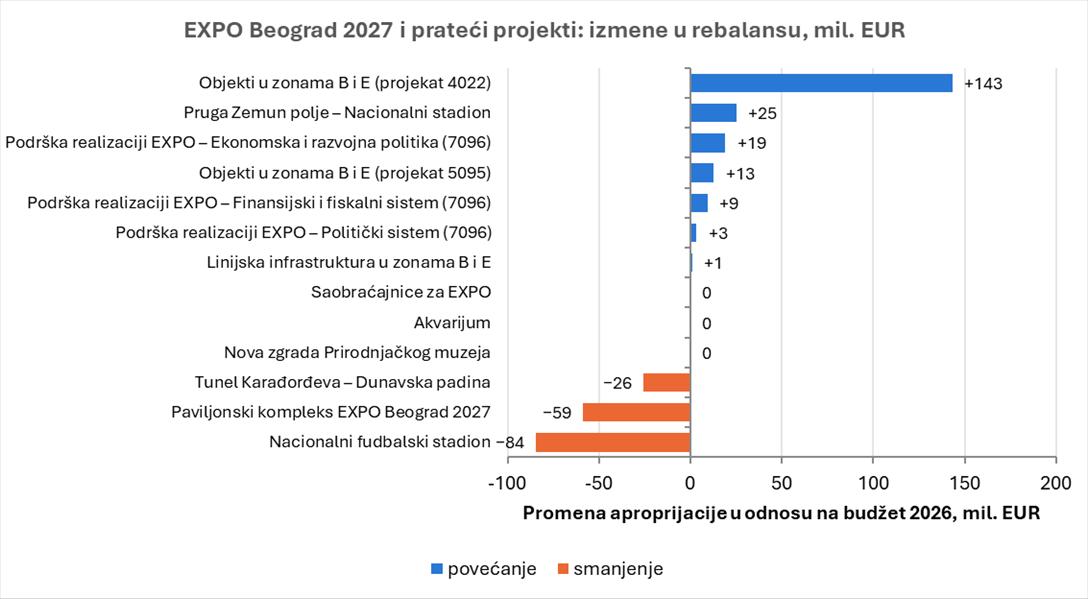
. including the new General Staff building as a new appropriation, thereby increasing military spending to 2.8% of GDP. On the other hand, the increase in funds for program 0701—according to the budget explanation—relates to additional funds for JP "Putevi Srbije" (Roads of Serbia), the road rehabilitation and traffic safety improvement project, and "Koridori Srbije" (Corridors of Serbia). Forbes Serbia wrote in more detail about budget subsidies to this public enterprise. The total increase for these two programs amounts to 0.5% of GDP. From a sectoral perspective, social protection (sector 09) represents the second largest source of increased budget appropriations, immediately after the financial and fiscal system, and contributes about 1.4 percentage points to the overall growth of the rebalance (out of a total expenditure increase of 6.2%). Appropriations for the four programs through which the largest part of the announced targeted benefits to the population are realized have increased by a total of about 0.5% of GDP (434 million euros). This amount does not include the portion of aid financed directly from the funds of the Share Fund, and therefore does not represent the total value of the announced package, making up slightly less than half of the announced benefits, which constitute about 1% of GDP (980 million euros). Although these measures are one-off, their volume significantly increases current spending in 2026 and represents one of the main reasons why the more favorable fiscal dynamics from the first half of the year will not be fully reflected in the annual result. At the same time, their one-off nature means that the effect on household disposable income and consumption will be predominantly temporary, without a permanent increase in their level.. Although appropriations for individual large construction projects within the EXPO complex are decreasing, total funds for EXPO Belgrade 2027 have been increased by the rebalance.
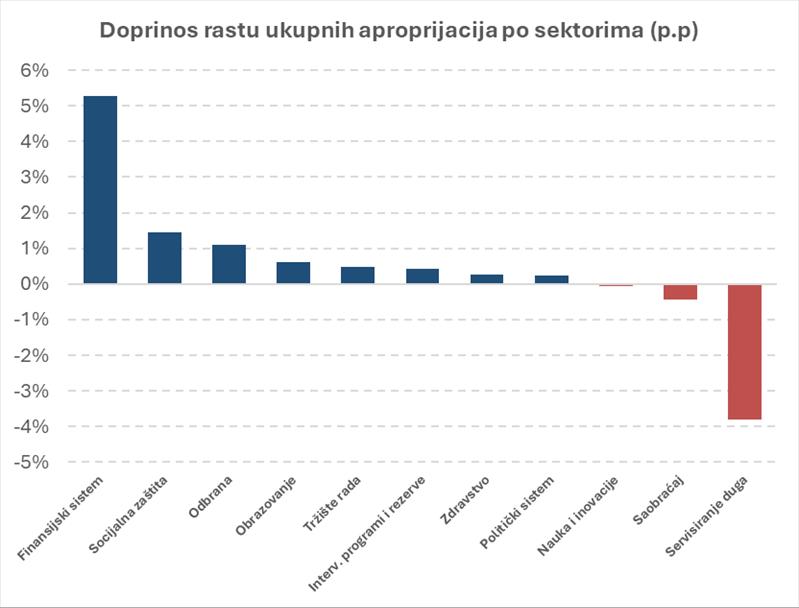
Funds for the construction of the National Stadium have been reduced by 46.6%, from 21.2 to 11.3 billion dinars, for the EXPO Belgrade 2027 pavilion complex by 16.1%, from 42.6 to 35.7 billion, while the appropriation for the tunnel from Karađorđeva Street to Dunavska Slope has been reduced by 60%. These reductions have, however, been more than compensated by new funds for site preparation in zones B and E, amounting to approximately 18.3 billion dinars, as well as additional funds for supporting the realization of EXPO, amounting to approximately 3.7 billion. In total, appropriations for the nine identified EXPO-related projects have increased by approximately 8.1 billion dinars, or 9%. Budget execution data from the Ministry of Finance indicate that the reduction in appropriations for certain large objects may reflect slower execution than originally planned, rather than an actual abandonment of these expenditures. Thus, by the end of June, only 24.9% of the annual appropriation for the National Stadium had been executed. It is also possible that some funds have merely been shifted to the plan for 2027, which could be more reliably assessed only based on a more recent revision of the Fiscal Strategy Annex. Such a redistribution is also visible at the level of the transport and communications sector, whose total appropriations have been reduced by 4% by the rebalance, despite an increase in funds allocated to JP "Putevi Srbije" and "Koridori Srbije". Among the largest increases in expenditure appropriations are one-off measures for the population, additional allocations for defense, and subsidies to public road companies, while funds for certain large infrastructure projects have been reduced. At the same time, the financing account foresees a significant increase in funds for the acquisition of domestic financial assets, most likely related to the possible acquisition of a part of NIS; this transaction increases the state's financing needs but does not represent an expenditure that affects the fiscal deficit. Overall, as we emphasized at the beginning of this analysis, the rebalance has a more pronounced distributive and short-term consumer character than a developmental-investment one, while any potential purchase of NIS should be considered separately from the budget's expenditure policy, given that it is in the financing account.
Of the total planned 73 billion, about 34 billion dinars can be linked to the payment of profit from the National Bank of Serbia into the budget. For the remaining approximately 39 billion dinars, the budget documentation does not provide a detailed breakdown by public and state-owned enterprises. One possible source could be EPS, which achieved a profit of over 40 billion dinars in 2025, but without a published decision on profit distribution, this cannot be confirmed at present. Funds for the construction of the National Stadium have been reduced by 46.6% from 21.2 to 11.3 billion dinars. for the EXPO Belgrade 2027 pavilion complex by 16% from 42.6 to 35.7 billion, while the appropriation for the tunnel from Karađorđeva Street to the Danube slope has been reduced by 60%. These reductions have, however, been more than compensated by new funds for site preparation in zones B and E, in the amount of approximately 18.3 billion dinars, as well as additional funds to support the realization of EXPO, amounting to approximately 3.7 billion. In total, appropriations for the nine identified projects related to EXPO have increased by approximately 8.1 billion dinars, or 9%. Budget execution data from the Ministry of Finance indicate that the reduction in appropriations for certain large facilities may reflect slower than initially planned realization, rather than an actual abandonment of these expenditures. Thus, by the end of June, only 24.9% of the annual appropriation for the National Stadium had been executed. It is not excluded that part of the funds has simply been shifted to the plan for 2027, which could be more reliably assessed only based on a more recent revision of the Fiscal Strategy Annex. Such a redistribution is also visible at the level of the transport and communications sector, whose total appropriations have been reduced by 4% by the rebalance, despite an increase in funds allocated to JP „Putevi Srbije“ and „Koridori Srbije“.
The structure of the rebalance shows that the increase in budget spending is predominantly directed towards current expenditures and transfers, while capital expenditures have increased significantly less. Among the largest increases in expenditure appropriations are one-off measures for the population, additional allocations for defense, and subsidies for public road companies, while funds for certain large infrastructure projects have been reduced. At the same time, the financing account foresees a significant increase in funds for the acquisition of domestic financial assets, most likely related to the possible acquisition of a part of NIS; this transaction increases the state's financing needs, but does not represent an expenditure that affects the fiscal deficit. Overall, as we emphasized at the beginning of this analysis, the rebalance has a more pronounced distributive and short-term consumer character than a developmental-investment one, while the eventual purchase of NIS should be considered separately from the budget's expenditure policy, given that it is in the financing account.
The question is not only what the short-term effect of such one-off payments is, but also their opportunity cost. The fiscal space used to temporarily increase disposable income could have been directed towards strengthening the state's capacities in areas where they are chronically insufficient. One such example is the inspection services, whose limited personnel and institutional capacities have been analyzed in more detail in the CEVES Stav text. Unlike one-off transfers, investments in the administrative and regulatory capacities of the state can have a more lasting effect on the quality of public services, the implementation of regulations, and the functioning of the economy.
[1] Of the total planned 73 billion, approximately 34 billion dinars can be linked to the payment of profit from the National Bank of Serbia into the budget. For the remaining approximately 39 billion dinars, the budget documentation does not provide a detailed breakdown by public and state-owned enterprises. One possible source could be EPS, which in 2025 achieved a profit of over 40 billion dinars, but without a published decision on profit distribution, this cannot be confirmed at the moment.