ALL ROADS LEAD TO SMES
Economic growth in Serbia in 2023 is estimated at 2.5%, while in 2024 it is targeted at 3.5% – insufficient for faster convergence of Serbia towards the (least developed) EU member states. The question increasingly being asked in public is how to accelerate growth? The answer is obvious – increasing domestic investments, but not simple or quick to implement.
Nevertheless, in addition to a series of demanding institutional reforms, there are also interventions through which the state can make significant progress in the short to medium term, show goodwill and sincere intentions, such as the introduction of a tax credit. Within 5 years, domestic investments would increase by as much as 40% – EUR 1.5 billion (in current amounts) annually.
Opportunities and signals for the necessary shift towards the domestic economy are numerous, and the most significant among them is the European Commission's growth plan for the Western Balkans, through which the EU is finally paying (somewhat) more attention to the intensity and quality of economic growth. Guided by the framework of this plan, it is possible to prioritize, reform-wise and financially, the strengthening of the domestic economy. And the pompously announced EXPO 2027 could subtly, but directly, serve as a showcase of the achievements of domestic champions.
ECONOMIC OBSERVATORY
Positive sentiment in Serbia; risk of recession spillover from Germany
According to the latest measurements of the EU's Economic Sentiment Indicator, Serbia recorded progress in the fourth quarter of 2023 and the beginning of 2024 – reaching an index value of 104.1. The positive economic climate in Serbia is also confirmed by GDP growth in the last two quarters of 2023 (3.6% and 3.8% respectively), accelerated inflation reduction in the past six months (from 10.1% in October to 5.7% in February), as well as a strong continuation of export and investment growth in 2023, with a stable labor market and real wage growth in the last quarter of 2023 (5.7%).
Economic sentiment in the European Union, and especially in Germany, showed no signs of recovery, remaining in the slightly negative zone for the EU, with an index of 95.4, and a worryingly low level for Germany (89 – a level not recorded in recent years, except during the pandemic). Recession in Germany has also been confirmed by the third consecutive quarterly decline in GDP and represents a significant risk for Serbia's economy, due to its close ties with the German economy (main trading partner).

Within the Bulletin, we present and interpret the regular survey of the economic sentiment index of the economy, which the Statistical Office of the Republic of Serbia regularly records for EUROSTAT. The composite index is the result of the difference between the number of positive and negative responses to questions about the state and expectations of „economic sentiment“, i.e., it represents the financial/economic situation expressed in four economic sectors (industry, retail, services, and construction) as well as among consumers. An index of 100 means that the number of those expecting improvement is the same as those expecting deterioration.
TAX CREDIT AND EXPO 2027 – AN OPPORTUNITY FOR THE STATE TO SHOW SUPPORT FOR SMES
Out of over 400,000 small and medium-sized enterprises operating in Serbia today, there is a segment of about 500 extremely competitive, innovative, growing, and export-oriented SMEs, which represent the hidden champions of the domestic economy. They employ 40,000 people and have a combined annual turnover of EUR 4 billion, of which EUR 2.4 billion comes from exports. With an adequate climate and institutional support, at least approximating that enjoyed by foreign direct investments, there would be several times more such champions.
The state has two good opportunities within reach to show that it is dedicated to them in practice, not just declaratively. The first is the reintroduction of the tax credit, which was also the message from the panel dedicated to SMEs at the Kopaonik Business Forum, and the second is EXPO 2027 , which can, and should, also serve as an EXPO for Serbian small and medium-sized enterprises. Their products and services should be woven into every segment of this event (as they produce everything needed for such a world exhibition). They have already proven their competitiveness in the demanding foreign market; it is time for them to be presented in their own country.

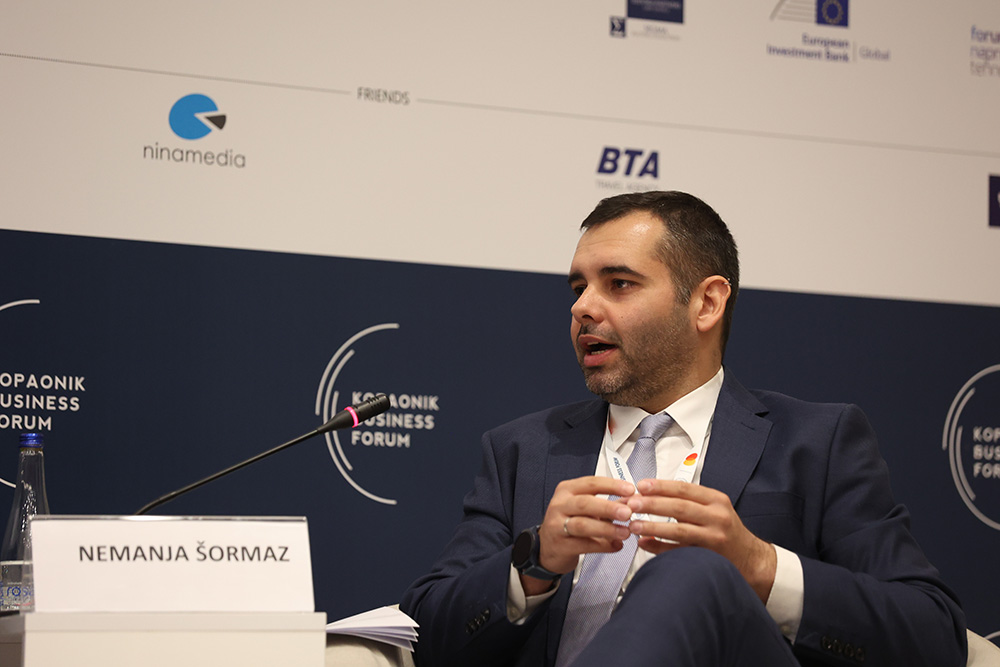
Photo: Kopaonik Business Forum // PANEL 20: Impact of Global Challenges on the Development of the SME Sector in Serbia
EFFECT OF THE TAX CREDIT FOR SMES
CEVES advocates for the reintroduction of the tax credit for small and medium-sized enterprises in Serbia, which existed until 2014. It is high time for Serbia to abandon the discriminatory practice, by which it is unique in Europe, of giving large companies the right to a privilege that small ones do not have. And then the state would have to start truly applying the principle of „Think Small First“.

* Effects refer to the introduction of a 10% tax credit, with a limit of 50% of collectible tax per year, with the right to carry forward for the next ten years.
Source: CEVES
CEVES POSITION
At the Palace of Serbia on January 20, the President of the state, in accordance with his constitutional powers, presented the plan „Jump into the Future – Serbia EXPO 2027". First of all, it should be noted that this plan has no adequate legal basis and was adopted outside of institutions, and everything indicates that it is motivated primarily by electoral success and the rating of the ruling party, rather than the development needs of the Serbian economy and society.
What does this plan promise? On the macro side, an increase in GDP to EUR 92.7 billion by 2027, which means a real growth of 4% on average annually (17% in total). Such growth was certainly predicted for Serbia by „default“ in the medium term, even without any additional reforms and more intensive investments. Such growth is insufficient for convergence and allows reaching only 80% of Bulgaria's development, and that is Bulgaria's 2023 development.
The plan is achieved through investments of EUR 17.8 billion, which sounds pompous in a multi-year sum, but does not deviate from the past. The insufficient growth is a consequence of a significant portion of investments being allocated to those whose priority and usefulness are highly questionable (from the National Stadium, through other new „second-league“ stadiums across Serbia, to the viewpoint on the Ovčar-Kablar Gorge). Measures for agriculture include higher subsidies, following an unchanged recipe and disconnected from results and desired outcomes – thus remaining closer to social policy than agricultural and development policy. The plan does not address domestic investments and the economy.
However, what interests citizens most in the plan is the promised increase in the average salary from EUR 836 to EUR 1,400. If the exchange rate remains stable and inflation is kept at the projected 3.5%, the real wage growth would be 46%. Real wage growth of 46% and economic growth of 17% would lead to a significant drop in productivity and, consequently, competitiveness, leading to the closure of companies for which doing business in Serbia becomes unprofitable.
Read the full analysis here.
GROWTH PLAN FOR THE WESTERN BALKANS
To regain momentum in the process of joining the European Union, the European Commission presented a New Growth Plan for the Western Balkans in November 2023, which is intended to accelerate the implementation of reforms and convergence towards EU standards.
However, despite the large number of ambitious requirements, the funds for their realization (only 0.6% of annual GDP) are not of adequate scope. On the other hand, as CEVES had the opportunity to learn, there is a concern that the accompanying government reform agenda will be reduced to a mere recycling of already existing and insufficiently ambitious documents, while much-needed reforms aimed at strengthening the economy will be absent. Given the long stick and the small carrot, it can be expected that Serbia will continue to turn to other international actors. In the period 2019-22, foreign direct investments from EU countries fell from EUR 2.2 billion to EUR 1.4 billion, while those from China increased from EUR 339 million to EUR 1.37 billion during the same period. Despite the shortcomings of the New Plan, Serbia should not „sit idly by“ but should make the best possible use of everything that is currently „on the table.“ Instead of repackaging existing plans, Serbia should seize the momentum and prepare a new one that, unlike the marketing plan „Serbia EXPO 2027„ and a lot of money for inadequate purposes, with not so much, but carefully directed money, could achieve, if not a leap, then certainly a “step towards the future.".
Read the full text here.
HIGHLIGHTS
- CEVES, in cooperation with EBRD and the EU, has begun mapping and defining priority interventions for the growth of SME competitiveness in the Western Balkans. The project is being implemented in coordination with regional partners and will propose changes in the areas of economic policies, digital transformation, and innovation to facilitate business operations and stimulate SME development. We invite everyone who has proposals and suggestions to contact us with their ideas.
- Kori Udovički presented the findings of CEVES's report at the Annual General Meeting of the German-Serbian Chamber of Commerce. Trade relations between Serbia and Germany in the period 2015-2022. Germany's position as the most significant partner has further advanced, so the volume of trade is almost double compared to second-placed Italy. Since 2019, Serbia has doubled its exports to Germany. Serbian products have consistently gained market share in Germany, both from new German FDIs and from the exports of Serbian SMEs. Germany is also the largest investor in Serbia's manufacturing industry, but it is concerning that in the last two years, the amount of investments from Germany to Serbia has halved, which represents a significantly more drastic drop than the drop in total investments from Germany worldwide (-13%). Ms. Udovički expressed hope that policies will gradually be developed that, along with this cooperation, will contribute to the development of Serbian SMEs into a „Serbian Mittelstand.“
- CEVES, as part of the „Sustainable Development for All“ Platform“ , participated in a press conference on March 13, at which the Platform called on the new Government of the Republic of Serbia to continue activities aimed at preparing and adopting the Development Plan of the Republic of Serbia and to incorporate into it the obligations undertaken by signing the United Nations' 2030 Agenda for Sustainable Development. This Plan must be prepared through broad, sincere, and visible dialogue and cooperation with all development actors in society – the economy (both small and large), and all other non-state actors, professional and business associations, academic organizations, and other civil society organizations.
- Within the regional network WEBecon, together with colleagues from the remaining five Western Balkan countries, CEVES is working on creating a regional study aimed at improving transparency and generating additional knowledge about state aid policies in the region. In addition, within the same consortium, a study is currently underway on promoting household energy security by developing the market for electricity prosumers.
- CEVES joined the SME HUB Caravan in Leskovac and supported the SME HUB project, which aims to help as many local companies as possible become global suppliers. The discussion covered potential cooperation between small and medium-sized enterprises and multinational companies, as well as financing business transformation and improving the SME sector.
Your CEVES Team
Kori Udovički, Nemanja Šormaz, Marijana Radovanović, Pavle Medić, Lana Hadži-Niković, Lazar Ivanović, Jelena Radulović, Viktor Bačanek, Ivona Janović, Simonida Kiš and Dušan Kovačević