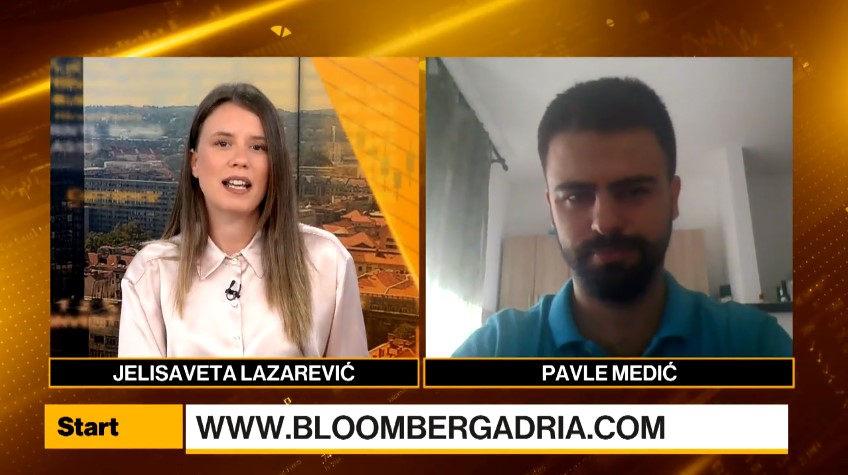
The state and retailers have reached an agreement to lower prices for 20 products starting from the middle of this week, and Pavle Medi, an economist at CEVES, says that this agreement has no potential to curb inflation expectations.
„This measure has no potential to significantly break inflation expectations because in inflation, almost everything is - and that is a fact, or an attempt to convince people that prices will no longer rise,“ he states.
Medić adds that this measure is more reminiscent of a social measure than an anti-inflationary policy. „Considering that the approved 20 products are essentially inferior substitutes for certain products, meaning lower quality products, and other countries that have implemented similar measures, for example, France, had a much broader scope of up to 5,000 products, if such a broad scope had been applied, you would not have had to cut prices so drastically.“
Medić explains that an additional problem is that this policy will have to be abandoned at some point. „It would be a much better policy to freeze or slow down price growth across a wider range of products than to drastically reduce it for a smaller range.“.
Medić also adds that the question arises as to what will happen when the agreement between traders and the state ceases to be valid and when prices from the beginning of 2024 return to 60-70 percent higher levels, but this is not the only challenge when it comes to inflation. „In October, you have an eight percent increase in excise duties, then in November, an increase in the price of electricity and gas. You have fiscal policy measures ranging from salary increases to these universal benefit measures again, which are also very inflationary. When you look at it, it seems to me that the current policy is pro-inflationary, not anti-inflationary.“
„Inflation, along with the slowdown of economies that are EU members, and the third consecutive bad year in agriculture will cost us economic growth,“ says Medić.
„Even the projected rate of 2.5 percent seems quite high to me, considering that in the first half of this year, the achieved rate was around 1.3 percent. In my opinion, there is no reason for optimism, and the first reason is agriculture, which after two bad years is entering its third consecutive bad year, driven primarily by export difficulties at the beginning of the year, and then by these adverse weather conditions,“ states Medić, adding that there is a serious danger of structural breaks, i.e., some permanent disruptions.
Also, he states, Serbia's largest trading partners from the European Union, Germany, the Czech Republic, Hungary, Austria, Poland, which are part of the automotive industry to which a significant part of our exports is linked, are recording negative growth rates during the second quarter. „We will see how this will translate into demand for Serbian industrial products. This is primarily the automotive industry, given that 80 percent of the SDI portfolio is precisely in that segment,“ says Medić.
„And thirdly, it seems to me that Serbia is still postponing the fight against inflation because there are still no serious anti-inflationary measures, and I say, this will have to happen at some point. I think it will be next year, and then it will cost us economic growth.“