
Small and medium-sized enterprises (SMEs) are the backbone of the domestic economy, generating 60% of added value, 66% of employment, and accounting for 45% of total exports. As such, they represent both the foundation and the driving force of the new Serbian economy, and possess exceptional potential to contribute to Serbia's sustainable development in the coming decade and the achievement of all the goals of Agenda 2030 for our country.
However, the domestic SME sector does not enjoy the same level of attention and support as large enterprises, and SMEs need to be placed at the center of development policies, is the main conclusion of the panel discussion It's time for SMEs! which was jointly organized by CEVES and the Chamber of Commerce and Industry of Serbia.
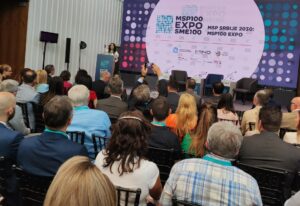
Within the framework of the „Sustainable Development for All“ Platform, the Centre for Advanced Economic Studies (CEVES) has been engaging in dialogue with key Serbian entrepreneurs for over two years regarding the development needs of the Serbian economy, in order to identify and launch initiatives that will contribute to the realization of this vision by 2030. On this occasion, a panel discussion was held today It's time for SMEs! at which representatives of small and medium-sized enterprises, state institutions significant for the development of the SME sector, the Chamber of Commerce and Industry of Serbia, and other stakeholders interested in the further development of the SME sector discussed what is needed for this part of the economy to continue to grow and contribute even more strongly to Serbia's sustainable development.
„There is a need for focus from the state, as well as society, on building a stimulating economic environment, and an end to practices that administratively and otherwise discriminate against SMEs compared to large enterprises. In their policies and financial resources, the balance of attention paid to SMEs and large enterprises must be equalized, in line with good EU practice,“ stated Nemanja Šormaz, Director of CEVES, during the introductory part of the panel, emphasizing that CEVES, together with other partners, will continue to advocate for initiatives identified by SMEs.
Although in the background compared to foreign direct investments (FDIs) and large state and public systems, SMEs show a continuous growing capacity and strength to play a key role in Serbia's further development. Despite a less than stimulating environment, the number of micro, small, and medium-sized enterprises increased by over 78,000 in the period 2015–2020 (of which 10,600 are new business entities), the number of employees increased by 163,742 (20.4%), the total growth of gross value added was 46.4%, while exports – the main indicator of competitiveness – increased by EUR 1.4 billion (26.8%).
„Our task is to help precisely the small ones and those who do not have their own internal resources, because they are the ones who need the most support from organizations. This is a task that must have a broad front of activists who help, who draw attention to the problems faced by small and medium-sized enterprises,“ said Mihailo Vesović, Director of the Sector for Strategic Analysis, Services, and Internationalization at the Chamber of Commerce and Industry of Serbia.
As one of the very significant obstacles to accelerating SME growth and productivity, discussion participants identified that SMEs are not exempt from profit tax on investments, as is the case with large enterprises – mainly from foreign direct investments – as well as the lack of adequate institutional support in international financial transactions (export insurance, guarantees), which is a practice in other European countries and in the region.
Dušan Šarković, owner and director of the company DMV Kontrolni sistemi from Niš, addressed the issue of tax credit, stating that most SMEs cannot cross the threshold of half a million euros in investments and 200 employees, which is necessary for this measure, and that it would be good to redefine this mechanism to include domestic small and medium-sized enterprises, as was the case until 2013.
The panelists agreed that small and medium-sized enterprises form the backbone of the domestic economy and make an immeasurable contribution to Serbia's exports and employment, especially in areas where foreign companies have no interest in operating, thereby strongly contributing to reducing inequality and depopulation in Serbia.
Participants in today's event included Mihailo Vesović, Director of the Sector for Strategic Analysis, Services, and Internationalization at the Chamber of Commerce and Industry of Serbia, Slavica Savičić, State Secretary at the Ministry of Finance, Tatjana Matić, Director of the Development Fund, Vesna Vučetić, Director of the Credits and Guarantees Sector at the Development Fund, Jelisaveta Lazarević, Vice-Dean and Assistant Professor at the FEFA Faculty, Dušan Šarković, owner and director of DMV Kontrolni sistemi from Niš, and Zorica Ilić, Financial Director of the company Dmiteh from Gornji Milanovac. The discussion was moderated by Marijana Radovanović, Development Advisor at CEVES.
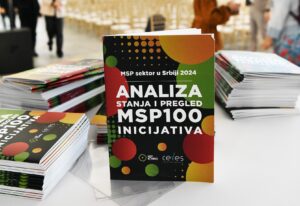
Within the exhibition part, leading domestic-owned SMEs in Serbia were presented, companies whose direct export of their own products and services to demanding markets has a value of over EUR 1 million in the last few years. The event is a continuation of the previously successfully organized conference MSP100 Expo, which Ceves organized at the beginning of June in Kragujevac.
The panel discussion and exhibition were organized by CEVES and the Chamber of Commerce and Industry of Serbia, within the framework of the „Sustainable Development for All“ Platform, supported by the governments of Switzerland and Germany, and implemented by GIZ as part of the „Public Finance Reform – Agenda 2030“ project.
[ngg src=“galleries“ ids=“66″ display=“basic_thumbnail“ thumbnail_crop=“0″ images_per_page=“46″]