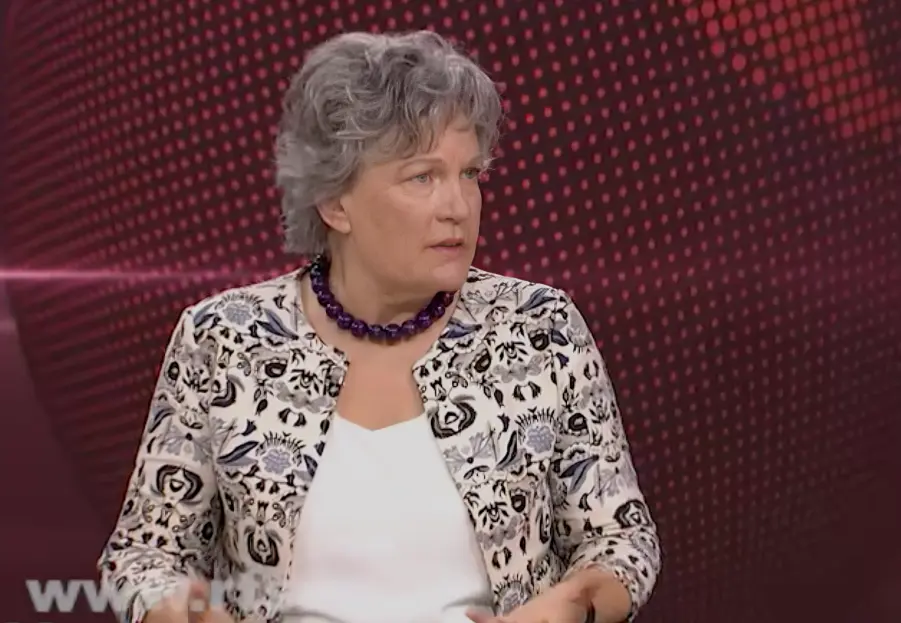
After the parliamentary elections, the NBS had to increase supervision due to the possibility of capital outflow, says former governor Kori Udovički, emphasizing that the key questions are how Alta banka ended up operating so poorly and why the authorities did not react immediately. She points to the unexplained origin of the bank's capital, but also, as she claims, to centralized decision-making and an atmosphere of fear within the NBS. She stresses that the banking system is stable. To cause a wider financial crisis, someone would have to seriously try, Udovički points out.
Former governor of the National Bank of Serbia, Kori Udovički, regarding the revocation of Alta banka's operating license, stated that citizens have no reason to worry about the stability of the wider financial system..
She recalls that during fiscal consolidation and cooperation with the IMF from 2014 to 2016, mechanisms were established that helped avoid a financial crisis, and that the National Bank of Serbia and the Ministry of Finance retained instruments for maintaining stability.
„Now, someone would have to try to create some kind of crisis event in a broader sense, and the levers of intervention from both the National Bank and the Ministry of Finance are in the hands of those who have been leading this for over a decade,“ Udovički said while appearing on RTS's Dnevnik.
„Every sector of the NBS monitors the bank's operations“
Speaking about the revocation of Alta banka's license, Udovički highlights two issues – how the bank ended up operating so poorly and why the authorities did not take measures earlier to prevent the outflow of money.
She believes that the opportunity to stop the transfer of funds to related party accounts or abroad was lost in the past week.
„The National Bank is not a mailbox. It is a huge institution where every sector – these are three of the four sectors led by members of the Executive Board, i.e., deputy governors – monitors some part of that bank's operations every day,“ Udovički emphasized.
Unexplained origin of capital
Udovički states that Alta banka reported a capital adequacy of 17.92 percent in June, but that the key issue is the origin and quality of that capital. She also points to the bank's last recapitalization, for which she claims the origin of the invested funds was unknown, noting that she does not have all the data to determine any supervisory failures.
„The problem is where that capital came from and what its quality was. And that's where the banking supervision sector, the financial sector operations, should have determined that,“ Udovički said.
She also points to the actions of the European Central Bank (ECB) regarding Alta Pay System's stake in Addiko Bank. According to her, the ECB suspended voting rights related to that stake due to uncertainties regarding ownership and the origin of capital.
„The European Central Bank actually suspended the voting rights of Alta banka, Alta Pay System, which is the owner, I think, I haven't memorized all the relationships now, but it suspended the voting rights of Alta banka, or the owner of Alta banka, in the Addiko system, where they bought a stake,“ Udovički stated.
As she explained, the reason for such a decision was doubts about who actually has voting rights in the ownership structure.
„It is not clear to us who is voting here,“ Udovički conveyed the European Central Bank's reasoning.
She says that representatives of the Center for Advanced Economic Studies, where she works, also pointed to the risks associated with Alta banka during the European Commission representatives' visit in September.
Could the National Bank have reacted earlier?
Udovički assesses that the NBS performed its job in most of the banking system, but the case of Alta banka shows serious problems. She particularly points to the issue of transferring money from the Ministry of Finance's treasury to a private bank and the need to determine who allowed it.
She emphasizes that the case of Alta banka is an isolated incident, although not the only one, and that the National Bank of Serbia did not treat the entire system in the same way.
„I return to this: the system is safe,“ Udovički stressed.
„The cause is not in the elections, but in dishonest business practices“
When asked if the problems at Alta banka would have occurred even without the parliamentary elections, Kori Udovički assessed that the cause of the crisis is not in the elections, but in, as she claims, dishonest business practices.
She believes that the change of government after the elections caused fear among those involved in such dealings, which, in her assessment, triggered events that led to the crisis in the bank.
„This situation would not have happened if someone here hadn't acted dishonestly. But since there were parliamentary elections, then that someone got scared and then it started to disrupt things,“ Udovički said.
Udovički believes that the NBS, especially after the parliamentary elections, had to increase supervision due to the possibility of capital outflow.
According to her, if the claims made public by lawyer Ivan Ninić about the transfer of funds to an account in North Macedonia are true, the NBS could have restricted the bank's international payment transactions without interrupting its domestic operations.
„That is a decision of the National Bank that has existed since 2007. No one had to hear about it, there was no need to create panic. The bank could have continued to operate domestically, while having increased supervision,“ Udovički explained.
Responsibility of deputy governors and decision-making process
Commenting on the information that four deputy governors warned of irregularities and called on the prosecution to react, Udovički asks why the problems were not noticed and stopped earlier.
As a possible explanation, she cites the extreme centralization of decision-making in the National Bank and an atmosphere of fear, about which, she says, she has knowledge from previous attempts to cooperate with that institution.
„I must say that it seems to me, or it is cynical naivety, that they will now shift responsibility from themselves, and each of them must have seen a part of the system,“ Udovički assessed.
This also indicates the fact that, Udovički claims, decision-making in the NBS is centralized and that „fear reigns there.“.
„NBS employees should respect the law, not incorrect instructions“
Udovički emphasizes that employees in institutions should act in accordance with their legal obligations, regardless of changes in government.
„I call on employees of the National Bank of Serbia to remember that their responsibility is before the law, not for following management if it gives wrong instructions,“ Udovički said.
What will happen to citizens' deposits and EPS's operations
Speaking about the consequences for depositors, Udovički states that the Deposit Insurance Agency will pay insured deposits up to EUR 50,000, but warns that this process may take time.
She also points out that public enterprises' deposits were not insured, which is why it is important for the authorities to ensure the continuity of their financial operations.
„I think that no Ministry of Finance, not even in a transitional government, will allow serious disruptions to the operations of EPS, whose payments have only been assigned to this Alta bank,“ Udovički said.
In her assessment, for payment system problems to threaten the supply of electricity and the stability of the power system, intentional disruption of multiple parts of the system would be necessary during the transitional period until the formation of a new government.
She believes that the competent institutions must take responsibility for the financial stability of Elektroprivreda Srbije, but she does not expect that the problems of Alta bank could by themselves threaten the supply of electricity.