
Dear friends, partners and colleagues,
This third newsletter of the year was meant to be a "special edition" on the budget revision, but it has, almost inadvertently, turned into a "special pre-election edition". As always, the CEVES Observatory examines the drivers of economic growth. We find that the acceleration of year-on-year growth to 3.8% reflects the expected pick-up in investment as we enter the final year before EXPO, some fortunate circumstances, as well as carefully designed macroeconomic policies geared towards boosting short-term consumption A total of some Eur 980 million (1% of GDP) of one-off giveaways to households will have been distributed before elections. These policies do so without significantly breaching the macroeconomic framework, but squeeze the elements of spending that contribute to longer-term development.
These observations draw in part on our analysis of the budget revision, presented here in abridged form; the full text is available here. We find that the government is funding pre-election spending and higher defence outlays by tapping a series of one-off "reserve pockets" and by revising upwards revenues that had been budgeted conservatively in the first place (a common practice that may look like prudent housekeeping but is in fact non-transparent), and by exceeding the deficit limit set by the fiscal rule, whose application has been postponed until 2029.
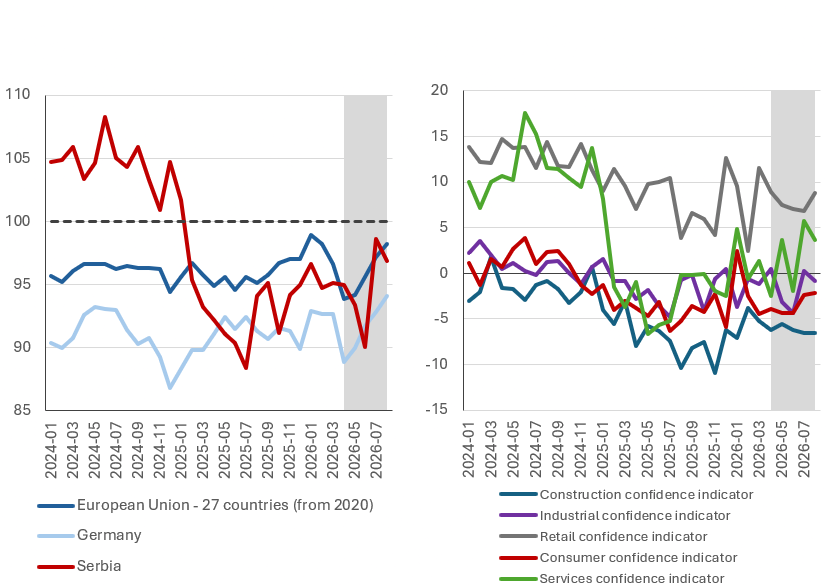
The recovery of economic sentiment in the EU is one of the "fortunate" circumstances we are benefiting from. However, we still cannot explain why, in Serbia, spending and retail trade sentiment are running high while consumer sentiment remains negative.
While initially we had intended to devote our CEVES Stance to conclusions on the budget, we then felt compelled to push back against the scaremongering in government-aligned media, which paint a catastrophic picture of the country's and the economy's future should the Student List win the elections. We fail to see how a parliamentary majority made up of thoughtful and responsible people could jeopardise the functioning of the state.
It is high time state institutions were given a chance to actually function, before their capacity is irretrievably lost.
In the "Activities" section, we present the project we have launched with BIRN to improve transparency and accountability in the management of public investment.
We hope you enjoy reading it!
CEVES Observatory
Year-on-year GDP growth accelerated to 3.8% in the second quarter, and the seasonally adjusted series confirms that this is not merely a base effect. Lively economic activity can be expected to last at least until the elections, judging by available third-quarter data and the fact that a total of some Eur 980 million (1% of GDP) of one-off giveaways will be distributed by then. Growth continues to rest primarily on household consumption (up 4.02% year on year, contributing 2.6 percentage points to GDP growth), driven by a number of unsustainable factors. It is also supported by a modest recovery in investment, long anticipated for this moment as Expo preparations enter their final phase.
Household consumption reflects the gradual, cumulative effect of favourable external conditions and a macroeconomic policy aimed at maximising short-term effects, on a continued foundation of strong real wage growth reflecting the structurally imbalanced labor market. Formally, this policy stays within the macroeconomic framework, but it draws down the "reserves" in the system. In recent months, these were extraordinary collections of revenue arrears. In the coming weeks, they will be the profits of the National Bank of Serbia (NBS), probably of public enterprises as well, and the Shareholders' Fund, accumulated over decades. Real wage growth, without commensurate productivity growth, is taking us over the medium-term towards economic stagnation.
The key external pillar has been favourable terms of trade, sustained over several quarters. Since late 2025, their effect has been amplified by a sharp fall in import prices. This has boosted real purchasing power and brought inflation down to around 2%, leaving room for accommodative monetary policy. Interest rate caps, first introduced by a temporary NBS decision and then by the Law on the Protection of Financial Service Consumers, have accelerated lending to households, particularly for housing (Belgrade again!). Household lending has become the largest single contributor to M3 growth, while interest rates on corporate loans have been rising since April. In other words, household consumption is growing primarily at the expense of SMEs. Wages are rising. The decline in employment in labour-intensive, low-wage, factories appears to have bottomed out, and there are early signs of modest employment growth among sole proprietors. Interestingly, despite this rise in consumption, consumer sentiment has remained firmly in negative territory since the January wage hike. The explanation may lie in the relationship between the consumption of the majority and that of a smaller number of households with high purchasing power, in line with the expectation that Expo-related investment and incentives benefit Belgrade above all. Against this argument, however, stands the fact that wages in the lowest deciles are growing fastest (for those who still have jobs), and that 70% of loans are cash loans.
Investment in fixed assets rose by 3.3% in real terms (contributing around 0.7 percentage points). This was to be expected given the acceleration of Expo works. Government capital expenditure (excluding payments for the Rafale jets in both the current and base periods) grew by around 12% in real terms. Also, after a steep drop in the first quarter, FDI returned to its 2025 quarterly level ( EUR 840 million). The NBS has been slow to publish data on its structure, but there is little doubt that it at least partly reflects investment in construction and related services, both related to Expo Exports accelerated slightly (6.9% in real terms), alongside the recovery in sentiment in the EU, particularly in Germany. They are, however, mostly driven by Stellantis (+40–50%, stabilising since July) and the metal sector (+27% in nominal terms), which includes the defense industry. In other words, this reflects a single factory and political decisions rather than broad-based gains in the competitiveness of the economy.
Analysis of the budget revision
The budget revision significantly expands the spending envelope relative to the original budget, by 1.5% of GDP (EUR 1.45 billion), or 6.3%. Macroeconomic and fiscal developments in the first half of the year were better than expected and opened up additional fiscal space. This space was further widened by raising the deficit from 3.0% to 3.5% of GDP (from EUR 2.9 billion to EUR 3.4 billion), which would have breached the limit set by the general fiscal rule had its application not been postponed until 2029.
The additional funds go predominantly to transfers, subsidies and one-off measures for the population: around 1.2% of GDP (EUR 1.2 billion), or four-fifths of the total increase. Capital expenditure rises by a mere 0.2% of GDP (EUR 170 million), while some investments, including Expo-related projects, are scaled back or postponed.
The additional fiscal space has thus not been used to address structural weaknesses or to build the state's administrative, regulatory and other capacities, even though these are precisely the areas with numerous long-standing shortcomings. The revision is therefore primarily redistributive and geared towards short-term consumption.
Chart 1 shows, on one side, the items whose appropriations were increased in the revision and, on the other, the sources from which these increases were financed. The increases total around 2.0% of GDP (EUR 1.9 billion), more than the net rise in expenditure of 1.5% of GDP, because some items were cut at the same time.
* Defence: the largest single increase, 0.35% of GDP (EUR 330 million), including equipment procurement and a new General Staff building.
* Subsidies to Roads of Serbia (Putevi Srbije) and Corridors of Serbia (Koridori Srbije): 0.2% of GDP (EUR 200 million).
* (Pre-election) measures for the population: four items through which these measures are mainly delivered rise by a combined 0.65% of GDP (EUR 620 million). They are child protection, the transfer to the Pension and Disability Insurance Fund, employment incentives, and a new Ministry of Finance appropriation that most likely represents the budget share of the one-off payment to adult citizens
The central budget, however, does not cover the full announced assistance package of around 1% of GDP (EUR 980 million), as part of it is financed from the Shareholders' Fund.
On the sources side, around a quarter of the increase is financed by a higher deficit, 0.53% of GDP. A slightly larger share, 0.55% of GDP (EUR 520 million), comes from non-tax revenue, namely profit and dividend payments. Part of this is the customary transfer of NBS profits, while the source of the remainder is unknown (public enterprises?). Tax revenue, by contrast, rises by a net 0.26% of GDP (EUR 240 million), as higher VAT and corporate income tax collection is partly offset by lower excise duties on petroleum products. The rest of the increase is covered by interest savings, 0.13% of GDP, and by cuts to funding for large infrastructure projects, 0.35% of GDP (EUR 330 million). In other words, the rise in current spending is largely financed by one-off resources, and it is unclear whether alternative uses of those resources, especially investment in the development of public enterprises, would not have been more justified.
Separately from expenditure, the financing account provides for around 1.5% of GDP (EUR 1.4 billion) for the acquisition of domestic financial assets, most likely the purchase of the Russian stake in NIS. The transaction does not affect the deficit, but it increases the state's borrowing needs.
Chart 1: 2026 budget revision: where the additional money goes and where it comes from (% of GDP)
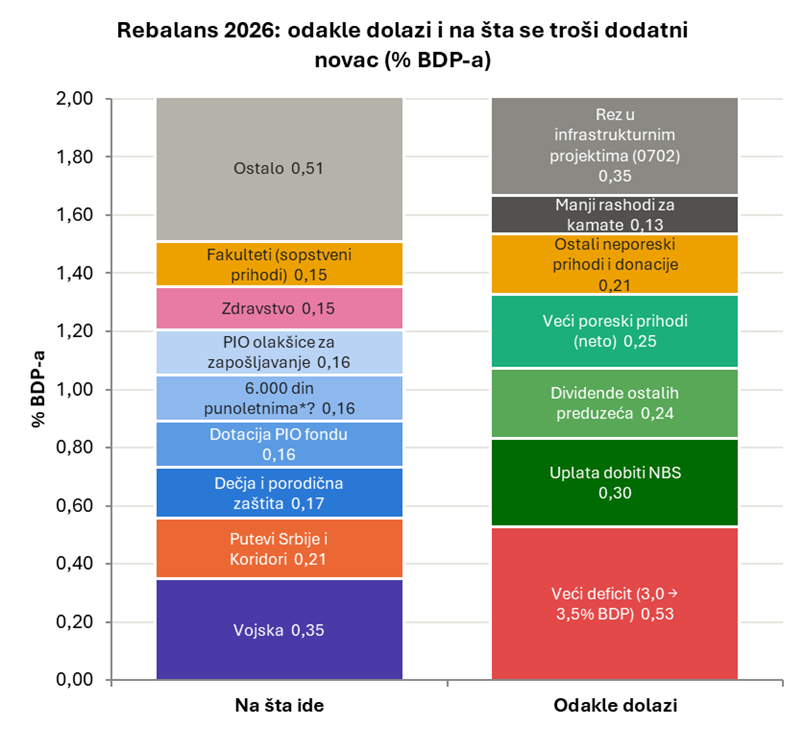
Note: The left bar shows items whose appropriations were increased; the right bar shows sources of financing, including interest savings and reduced or postponed funding for certain large infrastructure projects. This is why both bars (2.0% of GDP) exceed the net increase in expenditure (1.5% of GDP). Excluding financial transactions (principal repayments, NIS).
* Budget share of the one-off payment to adult citizens, according to the Fiscal Council. Source: Law on the Budget of the Republic of Serbia for 2026 and its revision; NBS; CEVES calculations.
On the sources side, around a quarter of the increase is financed by a higher deficit, 0.53% of GDP. A slightly larger share, 0.55% of GDP (EUR 520 million), comes from non-tax revenue, namely profit and dividend payments. Part of this is the customary transfer of NBS profits, while the source of the remainder is unknown (public enterprises?). Tax revenue, by contrast, rises by a net 0.26% of GDP (EUR 240 million), as higher VAT and corporate income tax collection is partly offset by lower excise duties on petroleum products. The rest of the increase is covered by interest savings, 0.13% of GDP, and by cuts to funding for large infrastructure projects, 0.35% of GDP (EUR 330 million). In other words, the rise in current spending is largely financed by one-off resources, and it is unclear whether alternative uses of those resources, especially investment in the development of public enterprises, would not have been more justified.
Separately from expenditure, the financing account provides for around 1.5% of GDP (EUR 1.4 billion) for the acquisition of domestic financial assets, most likely the purchase of the Russian stake in NIS. The transaction does not affect the deficit, but it increases the state's borrowing needs.
You can read the full analysis Here.
Economic sentiment: the EU and Serbia
The latest economic sentiment data (up to August 2026) point to stabilisation in Serbia, albeit still below the historical average. Overall sentiment has strengthened slightly since June, driven mainly by positive sentiment in retail trade and services, and has returned to its level at the start of the year. The improvement partly mirrors similar movements in the same indicator in Germany and the EU27; Serbia's readings have moved within a corridor between the EU27 and Germany.
Retail trade remains the main driver of positive sentiment, with positive readings throughout 2026. In August, the share of respondents who consider the current situation in the sector positive exceeded the share who consider it negative by a full 8.8 percentage points. Services have recovered from their June low in negative territory, with a jump in July (5.7 points) and a slight easing in August (3.6 points), remaining in positive territory.
Construction is stabilising, albeit in negative territory, as are industry and consumers, who also report an overall negative sentiment. Interestingly, consumer sentiment is predominantly negative even though consumption is growing relatively strongly. This may point to the structure of consumption: positive respondents may have considerably greater purchasing power than negative respondents, who are nonetheless more numerous.
CEVES Stance
If the Students Win – Welcome A State We Can Trust
There is no doubt that most citizens of Serbia want change, but many still do not know whom to entrust it to. For over a year now, student protests have enjoyed the support of about six out of ten citizens. CRTA’s June survey shows that seven out of ten undecided voters also support them; almost three-quarters of these voters have no confidence in the current government and, on other ideological issues, are very close to supporters of the “Students’ List – Students Win” electoral list. After the energy on display and the publication of the Students' List, this support is almost certainly even higher now.
This is CEVES's message to the undecided: if the students win, institutions will, for the first time, genuinely take on the roles they were designed for. This is the eleventh hour for it to happen, before the erosion of their capacity becomes irreversible, and now they have the chance. The fear being sold to the public is also misdirected: those who have reason to worry are the ones who stole and cheated, not citizens who want a better tomorrow. Parliament will set the rules of the game and hold the executive to account, and its majority will be made up of people who think for themselves. They do not need experience in government. What they need is an open mind, to invite and question experts, and to listen to their fellow citizens. These are precisely the kind of people the students have chosen.
Governing is not easy: the modern state is the most complex thing humanity has ever developed. But it is not easy to knock a state off course either: it is a tanker, not a speedboat. It is not steered by one man, or even by a couple of dozen ministers, but by a whole array of institutions. As we have seen every time Aleksandar Vučić needed months to form a cabinet, the tanker sails on even without one. Nothing will collapse when the ruling majority leaves office, except the parasitic system that has kept the country from progressing faster.
The students' plan, summed up in 11 points, gives the tanker a sufficiently clear direction. At its center is a goal that the students themselves have summarized: "We want to change the rules that allowed any government to gain this much power over institutions and citizens' lives." And the plan is well put together, with clear priorities:
Points 1–4: by restoring the fundamentals of the rule of law, it restores citizens' dignity, stops the plunder of public money and ensures that a government like this one cannot happen again.
Point 5: it recognises that institutions are made up of people and ties its goals to the professionalisation of public administration.
Points 6 and 7: it acknowledges that the current economic model has been obsolete, and turns to socio-economic progress based on knowledge, innovation, and the domestic economy.
Points 8–11: it sets priorities that directly concern citizens: security for workers, an end to unjustifiably high prices, and the most pressing problems facing the young and the old.
Among honest people, there can be no dispute over priorities such as these. The issues that deeply divide society – East or West, and the status of Kosovo – can safely wait a little longer, as indeed they have so far.
There are risks. The greatest is that the outgoing government chooses sabotage; the second is that the tanker starts to drift. We write about all these and related issues in more detail here, in an article that opens a series for the days ahead.
Activities
Strengthening Democratic Accountability in Serbia's Public Investment Governance
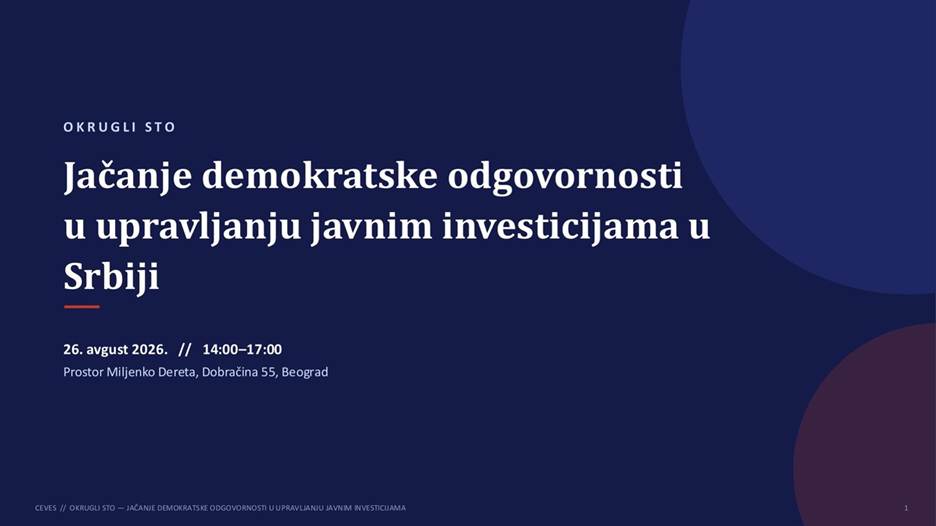
Together with the BIRN network, and with the support of the National Endowment for Democracy (NED), we have launched a project aimed at greater transparency and accountability in the management of large public investments. In the preparatory phase, we mapped 58 major capital projects based on the Fiscal Strategy, the Western Balkans Investment Framework (WBIF), and international loan agreements. At the first expert round table, held on 26 August, we discussed the key challenges in monitoring them. In the coming period, we will submit freedom of information requests and begin collecting and processing data on the mapped projects.
Training for civil society organisations
From 2 to 4 October, we are organising a training for civil society organisations on monitoring and analysing the national budget. It is part of a project under the EU's Civil Society Facility support programme, funded by the EU Delegation to Serbia. The strong interest shows how much this kind of support is needed. The knowledge gained will not stay with the participants alone: after the training, we will publish a Toolkit on our website with the training materials and answers to the most frequently asked questions.
Strengthening Democratic Accountability in Serbia's Public Investment Governance Together with the BIRN network, and with the support of the National Endowment for Democracy (NED), we have launched a project aimed at greater transparency and accountability in the management of large public investments. In the preparatory phase, we mapped 58 major capital projects based on the Fiscal Strategy, the Western Balkans Investment Framework (WBIF), and international loan agreements. At the first expert round table, held on 26 August, we discussed the key challenges in monitoring them. In the coming period, we will submit freedom of information requests and begin collecting and processing data on the mapped projects.
This document was produced with the financial assistance of the European Union. The contents of this document are the sole responsibility of CEVES and under no circumstances can they be regarded as reflecting the views of the European Union.
Your CEVES team:
Kori Udovički, Pavle Medić, Vojislav Stojanović, Ivona Janović, Dunja Paskota, Ivana Jovanović i Vladimir-Huba Aradi