
These were the main messages of the panel discussion "CBAM is just the first test: Why does Serbia need a green industrial policy?", organized by CEVES together with the Chamber of Commerce and Industry of Serbia, with the support of the Open Society Foundation – Western Balkans.
Miodrag Milosavljević, Deputy Director of the Open Society Foundation – Western Balkans, pointed out that CBAM should not be seen only as a threat. While it creates pressure, it also serves as an early warning, exposing the weaknesses in our development model and showing where we need to act faster, smarter, and more coherently. If taken seriously, CBAM can become Serbia’s first real test of whether it can move beyond adapting to rules set by others and begin shaping its own development strategy. This is why Serbia and the rest of the region need a green industrial policy – not another strategy left on a shelf, but a practical framework linking energy, industry, education, innovation, finance, and local development.
As of 2026, CBAM is no longer just a reporting regime: it is entering a phase of financial exposure for iron and steel, aluminum, fertilizers, cement, hydrogen, and electricity. If these industries want to avoid being charged based on punitively high default assumptions about their CO₂ emissions, they must prove what their actual emissions are. The formal obligation remains with EU importers and authorized declarants, but Serbian companies must provide per-product emissions data, the methodology used, verification, proof of carbon price paid, and documentation usable by their customers. "This process will not stop because of geopolitics. Whoever is rubbing their hands together waiting for this to pass is mistaken," said Siniša Mitrović, advisor to the President of the Chamber of Commerce and Industry of Serbia and head of the Circular Economy Center.
„This process will not stop because of geopolitics. Whoever is rubbing their hands and waiting for this to pass is mistaken,“ said Siniša Mitrović, advisor to the President of the Chamber of Commerce and Industry of Serbia and head of the Center for Circular Economy.
According to the CEVES report presented at the panel, exports of industrial CBAM goods from Serbia to the EU, excluding electricity, amounted to approximately €1.44 billion in 2025. Exposure is greatest in iron and steel (€930.8 million) and aluminum (€401.1 million), along with fertilizers (€103.3 million). Between 500 and 2,000 companies are affected by the process, either directly or through value chains, and the net cost of CBAM for 2026 is estimated at around €120 million.
CBAM is already changing business relationships. EU buyers are requesting estimates of embedded emissions, details of the methodology used, verification status, and information on the carbon price paid, while contractual clauses are increasingly shifting future CBAM costs, default-value risk, and verification risk onto exporters. Companies with lower actual emissions may lose their advantage if the data is not presented per product, verified, and accepted by the buyer.
Stanislava Simić, Director of the Association of Serbian Energy-Intensive Industries, pointed out that industry is preparing intensively, but that the challenge is not merely filling out reports: Serbia needs an environment that enables investment in decarbonization — a predictable regulatory framework, access to green energy, the use of alternative fuels and secondary raw materials, waste management reform, and the return of collected fees to the economy through concrete projects. Ljubica Drake, General Manager for Environmental Protection at HBIS Serbia, emphasized that CBAM is not the challenge of a single company but of the state as a whole: companies must link plant-level data with product-level data, ensure verification, and simultaneously plan costly investments.
The energy transition was presented as the biggest systemic challenge. The required investments from the public sector and state-owned energy companies are estimated at over 20 billion euros by 2030, while existing priority energy projects are already experiencing delays in preparation, problems with project documentation, property-legal issues, and significant cost increases. In this context, the direct CBAM cost for electricity exports was assessed as a lesser problem than the potential inclusion of EPS in a system equivalent to the EU ETS. Ljubo Maćić, an energy sector expert, warned that this scenario, depending on the CO₂ price, could create an annual cost of the order of 2-3 billion euros, which EPS and consumers could not currently bear without a clear decarbonization roadmap and EU support.
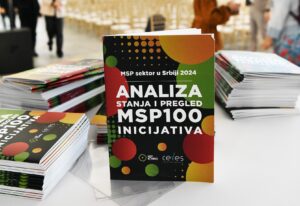
The conference also highlighted the weakness of domestic industrial policy. Serbia has a developed practice of attracting large investments, but it lacks a sufficiently strong system for the broad improvement of domestic companies, SMEs, and suppliers. Aleksandar Goračinov, Director of the SME Hub project, pointed out that small and medium-sized enterprises must overcome a series of preliminary steps before they can actively and effectively deal with CBAM and decarbonization, from management quality and internal procedures to data, financial planning, and the ability to respond to customer demands.
Ognjen Popović from the Ministry of Finance pointed out that the cost of CBAM is not a sufficient indicator of the overall challenge and that the issue must be approached holistically, through investments, competitiveness, financing, the energy sector, and access to European funds for decarbonization. He emphasized that unlocking these funds requires both the readiness of domestic institutions and an agreement with the EU, because without EU support, the Western Balkans risk falling far behind. Popović also announced that the Belgrade Stock Exchange is testing a platform for purchasing carbon credits, which would enable companies to financially manage CBAM risk.
The conference concluded that Serbia cannot wait for European aid to resolve domestic operational gaps. The next phase requires finalizing remaining secondary legislation for the carbon pricing law, establishing proof of paid domestic tax that EU declarants can use, opening visible budget lines for decarbonization in the 2027 budget, adopting a definition of green jobs, and preparing a clear roadmap for the power sector. Due to its complexity and significance, the green transition must be elevated to a higher political level.
The conference was organized by CEVES and the Chamber of Commerce and Industry of Serbia, with financial support from the Open Society Foundation – Western Balkans.