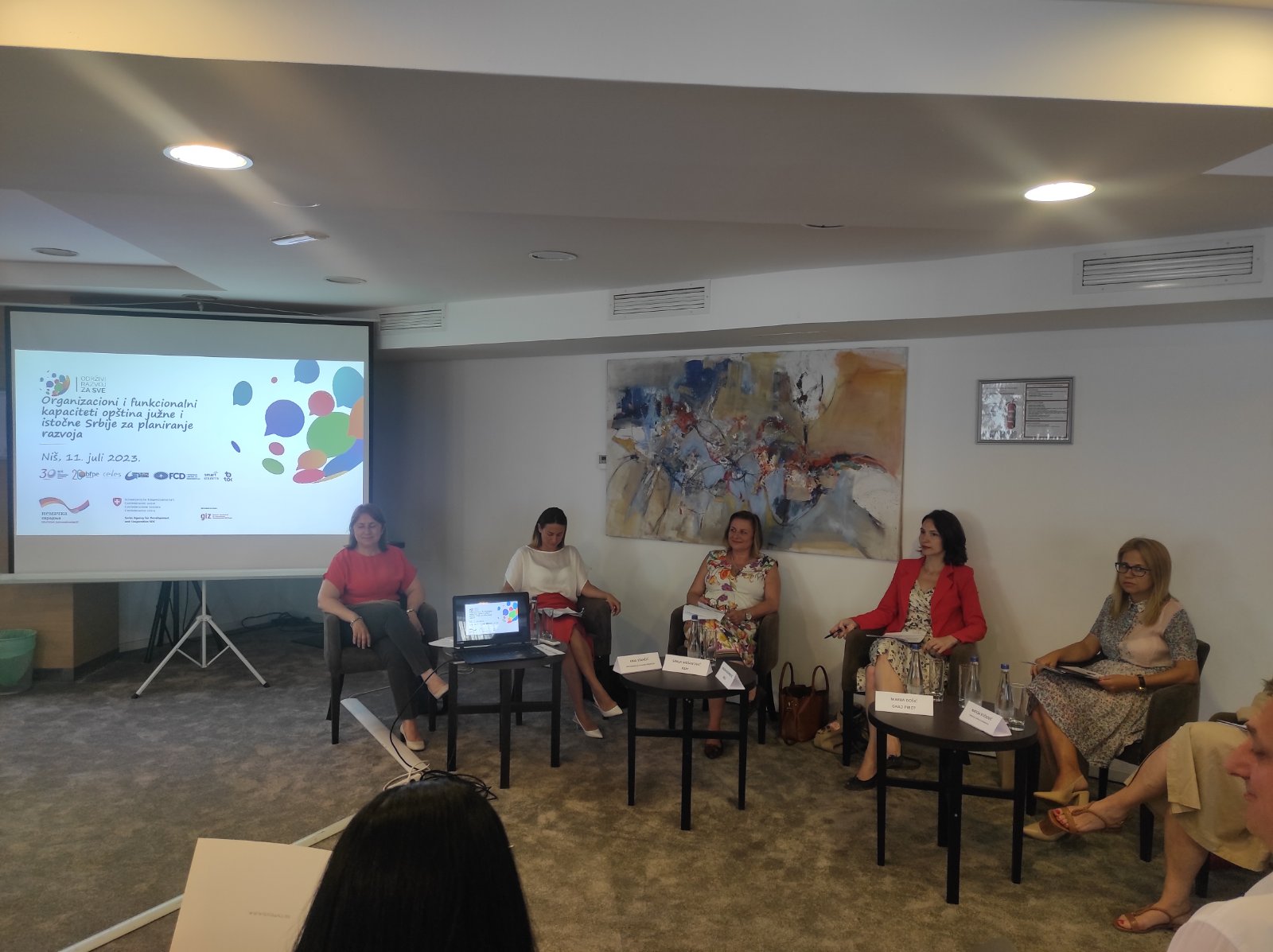
On Tuesday, July 11, 2023, a conference was held in Niš Improving Local Economic Development Planning through Inter-municipal Cooperation, organized by the Center for Advanced Economic Studies CEVES together with the Regional Development Agency South. This is the first of three planned events of the „Sustainable Development for All“ Platform, which aims to foster the exchange of knowledge and experience among municipalities and cities across Serbia regarding the localization of sustainable development goals and their integration into local planning documents. The event brought together representatives of local self-government units from Nišava, Pirot, Zaječar, Toplica, and Jablanica districts, central-level institutions, as well as development projects, agencies, and civil society organizations.
The conference began with a presentation of the questionnaire results on the organizational and functional capacities of local self-government units in four districts of Southern and Eastern Serbia necessary for implementing development planning processes, which was delivered by Tatijana Pavlović Križanić, an expert in local economic development. The recommendations arising from the questionnaire responses relate to improving the sustainability of the planning system, inter-municipal cooperation, and cooperation with the economy and civil society organizations.
The first panel was dedicated to reviewing the state of development planning in local self-government units in accordance with the principles of Agenda 2030. The panelists were Anja Stančić, senior advisor in the Cabinet of the Minister for European Integration, Sanja Mešanović, Deputy Director of the Republic Secretariat for Public Policy, Milena Radomirović, Director for the Planning System and Public Finance at the Standing Conference of Towns and Municipalities, Marija Đošić, Head of the Local Economic Development Office of the City Administration of Pirot, and Nataša Vučković, Secretary General of the „Center for Democracy Foundation“. The panelists agreed that further work is needed to strengthen the capacities of local self-government units for the preparation and implementation of planning documents, the standardization of these processes, prioritization in planning documents, as well as the predictability of financing for local self-government units.
The focus of the second panel was on examples of good and/or alternative practices in sustainable development planning, and among the panelists were Dragana Stojanović, Director of the Regional Development Agency South, Viktor Veljović, Capacity Building Manager of the EU PRO Plus program, Ivan Pavlović, Head of the Development Planning and Project Management Sector at KLER Niš, Dragan Mančev, member of the municipal council for economy and agriculture in the municipality of Dimitrovgrad, and Luka Milovanović, program assistant at the BFPE Foundation for Responsible Business. During the second panel, among other things, the initiative of the Regional Development Agency South to form regional councils that will actively cooperate with local self-government units was presented. The goal is for these councils, which will deal with issues of business and investment, infrastructure, agriculture and rural development, as well as social development, to provide concrete assistance to local self-government units by identifying common problems and developing initiatives towards decision-makers and donors, which will contribute to the joint development of local communities. During the panel, the importance of a participatory approach in defining the priorities of territories and local communities was highlighted, as well as the importance of considering the real possibilities of local self-government units and utilizing the existing knowledge and capacities of development organizations and other actors of sustainable local development.
Based on the discussions held during the conference, CEVES will prepare a document of conclusions and recommendations, which will define further work on improving local economic development planning and serve as a basis for future knowledge and experience exchange events through inter-municipal cooperation organized by the „Sustainable Development for All“ Platform.