On Thursday, March 3, 2022, CEVES and TOC, within the framework of the Platform „Sustainable Development for All“ organized an online conference „SME Serbia 2030: Skills Development as a Prerequisite for Domestic Economy Development“, which initiated a discussion on the skills needed for the future, i.e., skills that will simultaneously meet the growing needs of the economy and enable people to have decent employment and a quality life. This conference is another in a series of discussions within the SME Serbia 2030 Program, which aims to develop recommendations for improving the position of small and medium-sized enterprises in the domestic economy, thereby further ensuring sustainable development and decent work in line with Agenda 2030.
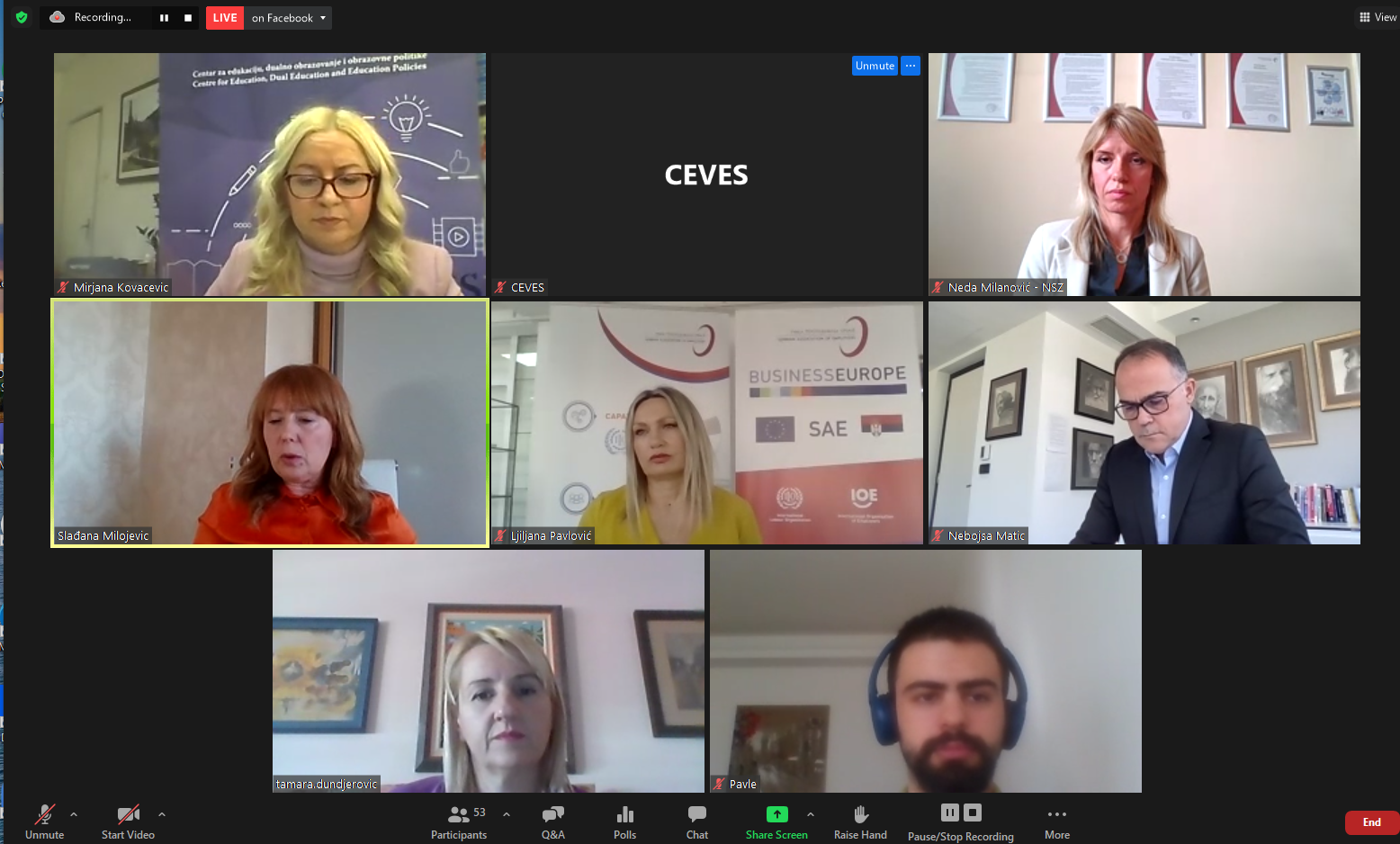
The participants of the first panel were Neda Milanović representing the National Employment Service (NES), Mirjana Kovačević representing the Chamber of Commerce and Industry of Serbia (CCIS), Ljiljana Pavlović representing the Employers' Union of Serbia (EUS), Nebojša Matić representing the company Mikroelektronika and Slađana Milojević representing the fashion industry cluster FACTS.
„There is no sector without professions in deficit,“ is one of the premises of the first panel, which discussed the alignment of economic needs and the motivation of the (un)employed. The lack of qualified personnel is felt at all educational levels and in many professions – Serbia lacks locksmiths, welders, food technologists, administrative workers, waiters, maids, cooks, bakers, textile workers, but also doctors, economists, lawyers, and of course engineers. The speakers highlighted the skills gap between the unemployed and the skills sought by employers, long-term unemployment, youth inactivity, brain drain, an aging workforce, and the lengthy process of integrating individuals into the workforce as key challenges. The fact that only 27% of young people are employed in a job for which they were educated indicates that this situation is not a legacy issue, but rather that the existing system is exacerbating the problem. On the other hand, employers' search for new personnel is often arduous – according to research by the Employers' Union, one-third of companies face significant difficulties in finding personnel, and small domestic companies are in a particularly challenging position. Although they offer opportunities for professional development in various positions due to their flexibility, they are still losing the battle against large companies that have well-established recruitment mechanisms and offer new employees a clearer career path.
It is very positive that both the state and employers and their associations have expressed great interest in resolving these issues. State activities are largely focused on activating the inactive and discouraged, especially young NEET individuals. Dual education programs have been present in Serbia for many years and generally yield favorable results – about 50% of students who go through the program find employment in their field. Also, the „My First Salary“ program has yielded solid results; however, a significant challenge remains the low interest of young people in moving to less developed regions. Employers and their associations have pointed out a number of innovative initiatives and ways to attract, develop, and retain personnel – higher salaries, reduced working hours, enabling employers to assist employees in purchasing apartments, as well as dual education for higher education levels. Certainly, these activities can provide significant support to the migration policy that Serbia must actively implement. In this context, Serbia is increasingly mentioned as a destination country for labor immigration – for more qualified personnel, it still mostly involves returnees who can be attracted mainly by more successful companies, while in the case of industries seeking lower-skilled labor, Serbia is slowly beginning to „import“ workers from less developed countries. What is certainly encouraging is the great willingness of all actors to cooperate and unite around a common goal – creating a dynamic market for decent employment.
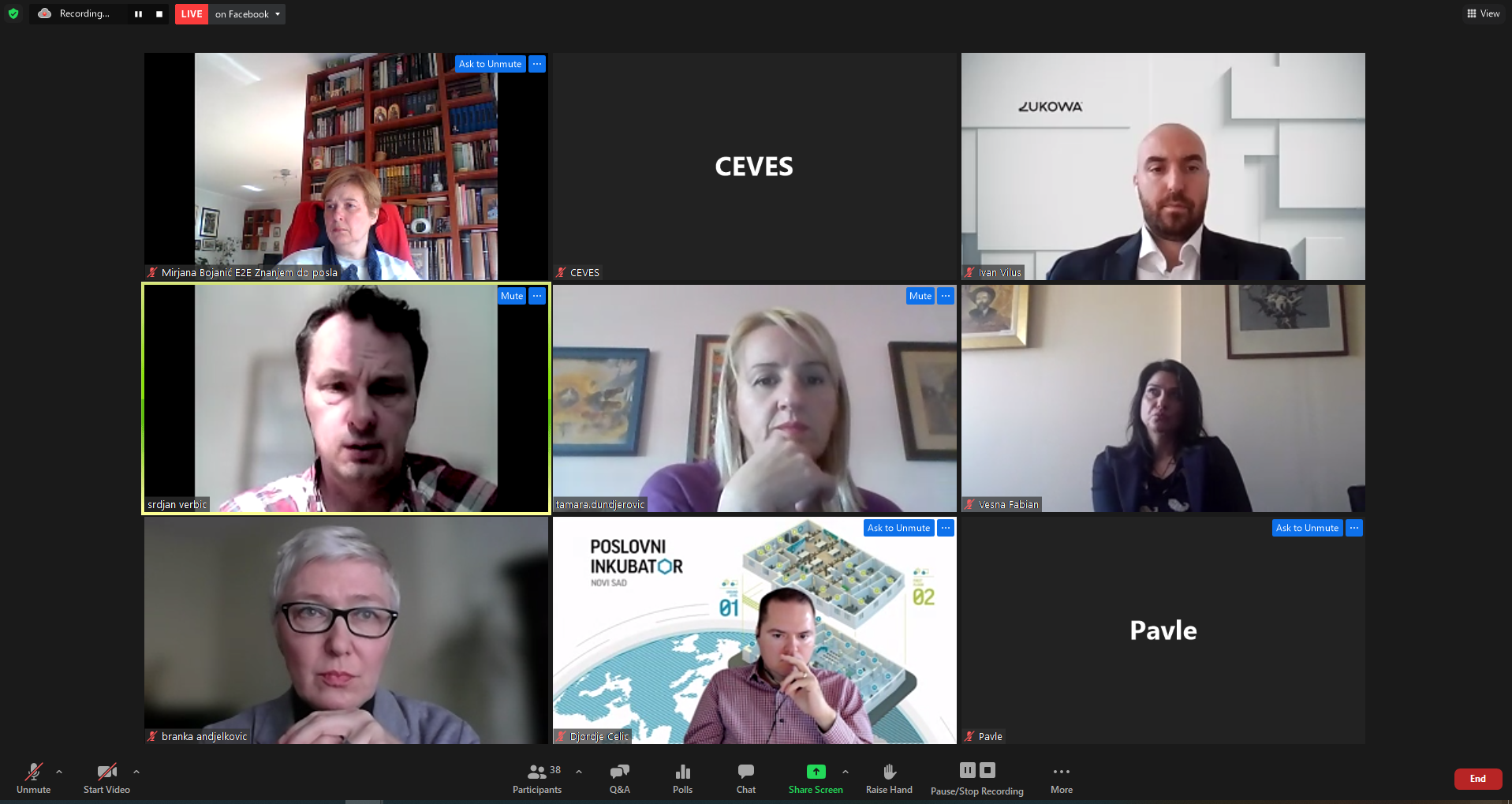
The second panel featured speakers Vesna Fabian representing the Ministry of Education, Science and Technological Development, Srđan Verbić representing the FEFA Faculty, Branka Anđelković representing the Public Policy Research Center, Ivan Vilus representing the LUKOWA company, Mirjana Bojanić representing the project "Knowledge for Employment" and Đorđe Ćelić representing the Novi Sad Business Incubator.
The focus of the second panel was on the future of work and the education system, in the context of the prerequisites, profiles, and skills that will be needed by the economy and that will enable decent work and a better quality of life, as well as other effects and challenges that will arise from a future marked by globalization and technological progress. Significant efforts have been invested by the Ministry of Education in the previous period, and the importance of involving the economy in all phases of education – from the creation of curricula to their implementation – has been recognized. The speakers at the panel agreed that primary education plays a crucial role in equipping students for life and providing them with the set of skills that will enable them to make rational decisions about their future, while the role of secondary education and higher vocational schools should be focused on the needs of the economy and skills for productive employment.
Among the challenges that the future brings, and to which all stakeholders will need to respond, the discussion highlighted lifelong learning, the generational gap in digital literacy, new forms of work, workers' rights and safety, career guidance, as well as soft skills. ). Europe, and Serbia as well, will have to undergo a comprehensive retraining process – European strategies predict that as much as 50% of the working-age population will have to undergo retraining. Similarly, in Serbia's case, this applies to the introduction of enrollment quotas – as the panel also discussed, between the lines, a kind of inflation of higher education. One of the solutions for faster adaptation and acquisition of new skills, which formal education, despite the best intentions and high efficiency, could not keep up with, is also highlighted by non-standard forms of supplementary education, in the form of various types of courses, which are already yielding good results in the IT industry. Another challenge that requires special attention is the growing asymmetry between the rights and power of employers at the expense of workers. Legal solutions in Serbia are still insufficiently flexible and diverse to regulate labor relations and provide various types of "platform" and other non-standard workers with adequate legal protection and employment rights. Legislators – both European and domestic – will certainly not find it easy to align with the vision of decent work in regulating future work arrangements.Europe, and Serbia as well, will have to go through a comprehensive retraining process – European strategies predict that as much as 50% of the working-age population will have to undergo retraining. Also, in Serbia's case, the same applies to the introduction of enrollment quotas – since the panel also discussed, between the lines, a kind of inflation of higher education. One of the solutions for faster adaptation needs and acquiring new skills, which formal education, despite the best intentions and great efficiency, could not keep up with, is also highlighted by non-standard forms of supplementary education, in the form of various types of courses, which are already yielding good results in the IT industry. Another challenge that requires special attention is the growing asymmetry between the rights and power of employers at the expense of workers. Legal solutions in Serbia are still insufficiently flexible and diverse to regulate the employment relationship and provide various types of „platform“ and other non-standard workers with adequate legislative protection and employment rights. Legislators – both European and domestic – will certainly not find it easy to align with the vision of decent work in terms of regulating future work arrangements.
Of course, it is not possible to predict everything that the future holds, but it is undeniable that the readiness for adaptation of all stakeholders and their continuous cooperation have the greatest chance of finding and implementing the highest quality solutions.
You can watch the entire conference on CEVES' Facebook page.
The conference was held within the framework of the „Sustainable Development for All“ Platform, supported by the Governments of Switzerland and Germany, and implemented by GIZ within the project „Public Finance Reform – Agenda 2030“.